Two Variables, One Line: CBSE Class 9 Mathematics practice questions
Practise 50 questions on Two Variables, One Line, free, with an explanation for each answer.
Sample questions
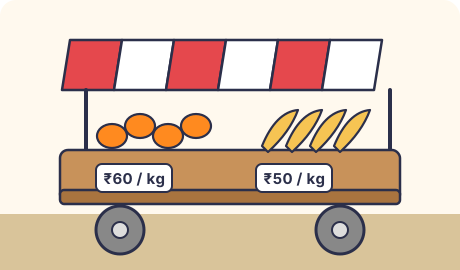
Radha buys kg of mangoes at ₹60 per kg and kg of bananas at ₹50 per kg. She pays ₹280 in all. Which equation shows her purchase?
Show the answer
A.
The mangoes cost rupees and the bananas cost rupees, so the total cost gives . Writing swaps the prices between the fruits. forgets the prices and adds kilograms to rupees, and wrongly treats both fruits as costing the sum of the two prices.
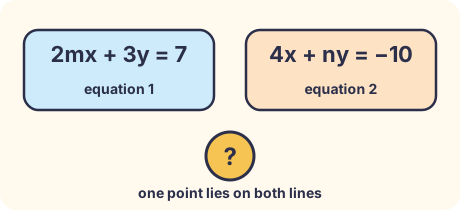
The point lies on both lines and . Find and .
Show the answer
B.
First equation: . Second: . Traps: forgetting the gives , treating as gives , and writing gives .
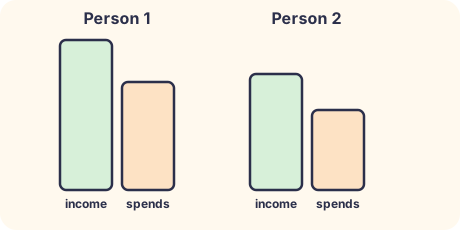
The incomes of two people are in the ratio . Their expenses are in the ratio . Each of them saves ₹3,000 a month. What is the monthly income of the first person?
- ₹27,000
- ₹3,000
- ₹21,000
- ₹24,000
Show the answer
A. ₹27,000
Multiply by 3 and 4: and . Subtracting the first from the second gives , then gives . The first income is . ₹3,000 is just , ₹21,000 is the second income, and ₹24,000 is the first person's spending .
Topics covered
- Forming a linear equation
- Standard form
- Linear equations in two variables
- Solution of an equation
- Finding unknown constants
- Solutions of an equation
- Intercepts on a graph
- Points and the line
- True or false about linear equations
- Lines through the origin
- Slope from two points
- Slope of a ramp
- Rise and run
- Slope-intercept form
- Graph of a line
- Types of slope
- Vertical and horizontal lines
- Parallel lines
- Comparing steepness
- Forming equations
- Pair of equations from a situation
- Solving a puzzle with two equations
- Substitution method
- Angles of a triangle
- Elimination method
- Elimination step by step
- Consistency of a pair
- Unique solution condition
- Coincident lines
- Number of solutions
- Graphs of pairs of equations
- Fraction problem
- Age problem
- Notes problem
- A Pinch of History
- Graphical solution
- Reading an intersection
- Identifying a line
- Two plans compared
- Choosing a plan
- Temperature conversion
- Meeting point of two paths
- Cyclic quadrilateral
- Graphical method
- Ordering slopes
- y-intercepts
- Solutions on a fruit bill
- Substitution step by step
More CBSE Class 9 Mathematics chapters
- Orienting Yourself: The Use of Coordinates
- Introduction to Linear Polynomials
- The World of Numbers
- Exploring Algebraic Identities
- I’m Up and Down, and Round and Round
- Measuring Space: Perimeter and Area
- The Mathematics of Maybe: Introduction to Probability
- Predicting What Comes Next: Exploring Sequences and Progressions
- Propositions and Their Converses
- How Quantities Combine: Understanding Data
- The World of Algorithms
- Quadrilaterals
- Math of Space: Surface Area and Volume