Predicting What Comes Next: Exploring Sequences and Progressions: CBSE Class 9 Mathematics practice questions
Practise 50 questions on Predicting What Comes Next: Exploring Sequences and Progressions, free, with an explanation for each answer.
Sample questions
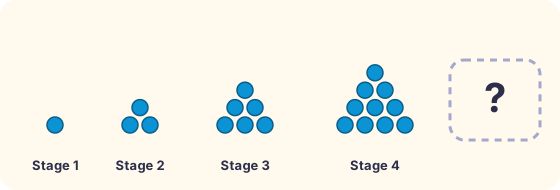
These dot triangles show the first four triangular numbers: 1, 3, 6, 10. How many dots are needed for Stage 5?
- 14
- 15
- 16
- 13
Show the answer
B. 15
Each triangular number is the sum of the counting numbers up to its stage: . The gaps between terms grow , so after we add . Adding again gives (forgetting the gap grows), and is the next square number, not triangular.
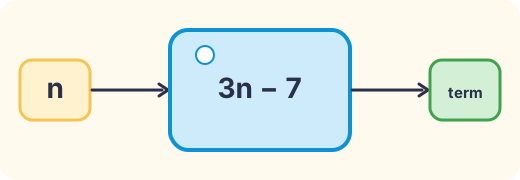
For the sequence , which term number is ?
- 111
- 108
- 113
- 339
Show the answer
C. 113
Set , so and . So is the 113th term. Dividing by and rounding gives , subtracting instead of adding gives , and is the value of , not the position .
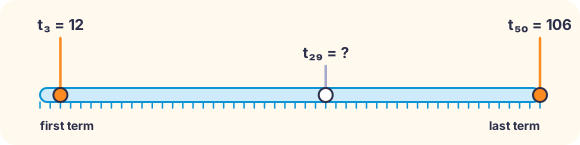
An AP has terms. Its third term is and its last term is . What is the 29th term?
- 64
- 66
- 58
- 62
Show the answer
A. 64
Subtracting gives , so and . Then . Using is the slip, forgets , and is one term too early.
Topics covered
- Triangular numbers
- Rules for common sequences
- Notation t_n
- Odd numbers and squares
- Explicit rule
- Position of a term
- Is a number a term?
- Recursive rule
- Recursive rules
- Virahanka-Fibonacci sequence
- Explicit rules
- nth term of an AP
- Graph of an AP
- AP in real life
- Term number of an AP
- Finding a and d
- Sum using S_n
- Sum of natural numbers
- Visual proof of S_n
- Identifying a GP
- AP or not
- Growing GP pattern
- nth term of a GP
- Which term of a GP
- Graph of a GP
- Graphs of AP and GP
- Types of progression
- AP and GP together
- Sierpinski triangle
- Fractals
- Sierpinski carpet
- Bouncing ball GP
- GP in real life
- Counting terms of an AP
- GP from conditions
- Consecutive sums
- Progressions in real life
- Comparing terms
More CBSE Class 9 Mathematics chapters
- Orienting Yourself: The Use of Coordinates
- Introduction to Linear Polynomials
- The World of Numbers
- Exploring Algebraic Identities
- I’m Up and Down, and Round and Round
- Measuring Space: Perimeter and Area
- The Mathematics of Maybe: Introduction to Probability
- Propositions and Their Converses
- How Quantities Combine: Understanding Data
- The World of Algorithms
- Quadrilaterals
- Two Variables, One Line
- Math of Space: Surface Area and Volume