Introduction to Linear Polynomials: CBSE Class 9 Mathematics practice questions
Practise 50 questions on Introduction to Linear Polynomials, free, with an explanation for each answer.
Sample questions
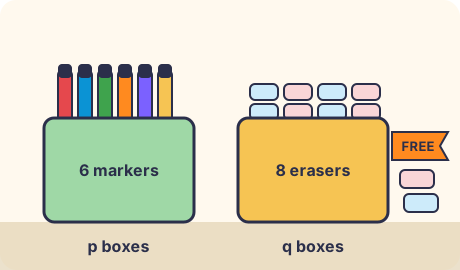
A shop sells green boxes with 6 markers each and yellow boxes with 8 erasers each. Ananya buys green boxes and yellow boxes, and also gets 2 erasers free. Which expression gives the total number of items she takes home?
Show the answer
B.
green boxes hold markers and yellow boxes hold erasers. Adding the 2 free erasers gives . swaps the box sizes, forgets the free erasers, and wrongly multiplies the two kinds of boxes together.
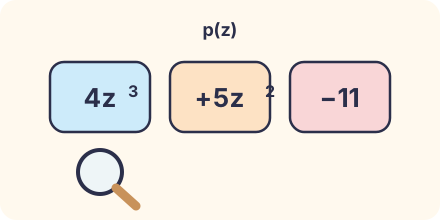
What is the coefficient of in the polynomial ?
Show the answer
C.
Writing every power in turn gives , so the coefficient of is 0: there is no term at all. is the coefficient of , is the coefficient of , and is the constant term, not a coefficient of .
Ruhi has twice as many ₹2 coins as ₹5 coins. Together the coins are worth ₹126. How many coins of each kind does she have?

- 14 coins of ₹5 and 28 coins of ₹2
- 28 coins of ₹5 and 14 coins of ₹2
- 18 coins of ₹5 and 36 coins of ₹2
- 42 coins of ₹5 and 84 coins of ₹2
Show the answer
A. 14 coins of ₹5 and 28 coins of ₹2
With coins of ₹5 and coins of ₹2, the value is , so : 14 coins of ₹5 and 28 coins of ₹2 (₹70 + ₹56 = ₹126). Swapping them gives ₹168. 18 and 36 come from (forgot that there are two-rupee coins), and 42 and 84 come from counting coins, , instead of rupees.
Topics covered
- Terms and constants
- Coefficients
- Types of polynomials
- Degree of a polynomial
- Linear polynomials
- Constant polynomials
- Algebraic expressions
- Terms, coefficients and variables
- Evaluating expressions
- Linear equations
- Polynomials as functions
- Linear patterns
- Linear decay
- Linear expressions in daily life
- Linear growth
- Linear growth and decay
- Finding a linear relationship
- Linear relationships
- Points on a line
- Drawing the graph of a line
- Slope of y = ax
- Negative slope
- Slope and y-intercept
- y-intercept
- Where a line meets the axes
- Equations and graphs
- Parallel lines
- Finding a linear polynomial
- Finding linear polynomials
- Linear functions
More CBSE Class 9 Mathematics chapters
- Orienting Yourself: The Use of Coordinates
- The World of Numbers
- Exploring Algebraic Identities
- I’m Up and Down, and Round and Round
- Measuring Space: Perimeter and Area
- The Mathematics of Maybe: Introduction to Probability
- Predicting What Comes Next: Exploring Sequences and Progressions
- Propositions and Their Converses
- How Quantities Combine: Understanding Data
- The World of Algorithms
- Quadrilaterals
- Two Variables, One Line
- Math of Space: Surface Area and Volume