The World of Algorithms: CBSE Class 9 Mathematics practice questions
Practise 50 questions on The World of Algorithms, free, with an explanation for each answer.
Sample questions
In Step 3 of the addition algorithm, one column has two digits and a carry. What is the largest total that one such column can have?
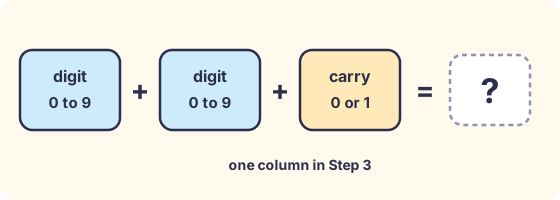
- 18
- 19
- 20
- 10
Show the answer
B. 19
The biggest digit is and the biggest carry is , so the largest column total is . Writing the units digit and carrying shows the carry can never be more than . forgets the incoming carry; would need a carry of , which never happens; is a possible column total (for example ) but not the largest.
Follow the column-addition steps exactly to add .
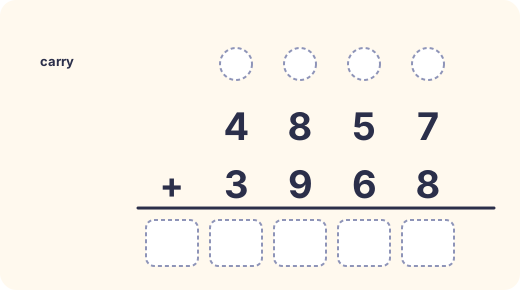
- 8725
- 7715
- 8815
- 8825
Show the answer
D. 8825
Units: , write , carry . Tens: , write , carry . Hundreds: , write , carry . Thousands: . Answer . is what you get by forgetting every carry; forgets the carry into the hundreds; forgets the carry from the units column into the tens.
Using the column algorithm, add the 5-digit number to the 3-digit number . Which is the correct result?
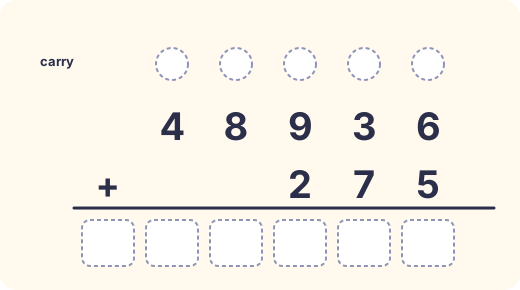
- 76436
- 48211
- 49211
- 49201
Show the answer
C. 49211
Units (write 1, carry 1); tens (write 1, carry 1); hundreds (write 2, carry 1); thousands ; ten-thousands . Result . comes from aligning the left ends (); stops adding once runs out and drops the carry; forgets the carry from the units column.
Topics covered
- Where the carry is written
- Adding 4-digit numbers
- Numbers of different lengths
- Why the carry is at most 1
- Steps of the addition algorithm
- Why the last step is needed
- Time to add by columns
- Counting vs columns
- Adding decimals
- Tracing the divisors algorithm
- Divisors in pairs
- Examining fewer numbers
- Order of the list of divisors
- Reading a flowchart: the decision
- Reading a flowchart: the loop
- Flowchart symbols
- Counting loop tests
- Following the flowchart
- Common divisors list
- Elements of one list not in another
- Facts about the divisors algorithm
- Efficiency of gcd scans
- Bound on common divisors
- Tracing the common-divisor scan
- Reading a flowchart: update step
- Which k update d
- Counting tests in a scan
- Which pairs have gcd 6
- Why Euclid's reduction works
- Tiling picture of m - n
- Counting subtraction reductions
- Slow case of subtraction
- Computing a gcd with Euclid's method
- Counting divisions
- Next pair in the remainder method
- Chain of reductions
- Stopping test
- Loop in Euclid's algorithm
- Where the answer is produced
- Why Step 1 reverses
- Tracing the flowchart
- Remainders
- Speed of the subtraction algorithm
- Why remainders are faster
- Remainder method for a hard case
- An algorithm for lcm
- prime(n) using divisors(n)
- primedivisors(n)
- Prime factorisation as a list
- History of algorithms
More CBSE Class 9 Mathematics chapters
- Orienting Yourself: The Use of Coordinates
- Introduction to Linear Polynomials
- The World of Numbers
- Exploring Algebraic Identities
- I’m Up and Down, and Round and Round
- Measuring Space: Perimeter and Area
- The Mathematics of Maybe: Introduction to Probability
- Predicting What Comes Next: Exploring Sequences and Progressions
- Propositions and Their Converses
- How Quantities Combine: Understanding Data
- Quadrilaterals
- Two Variables, One Line
- Math of Space: Surface Area and Volume