Quadrilaterals: CBSE Class 9 Mathematics practice questions
Practise 50 questions on Quadrilaterals, free, with an explanation for each answer.
Sample questions
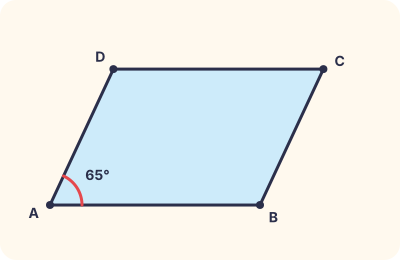
In parallelogram ABCD, . Find .
Show the answer
C.
with transversal AB, so (interior angles on the same side). Hence . Traps: is the opposite angle, not the adjacent one; comes from using ; uses instead of .
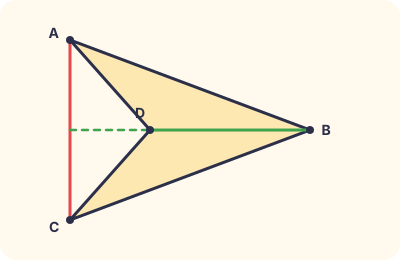
In the quadrilateral shown, the two diagonals (solid lines) do not meet. They would meet only if one of them were extended. What can you say about this quadrilateral?
- It is convex, because the diagonals are drawn inside the figure
- It is a parallelogram, because the diagonals are not equal
- It is non-convex: one internal angle is more than
- It is self-intersecting, because the diagonals do not cross
Show the answer
C. It is non-convex: one internal angle is more than
The diagonals of a convex quadrilateral always intersect; if they do not, the quadrilateral is non-convex and has a reflex angle () at the dent. The figure has no crossing sides, so it is not self-intersecting, and a parallelogram is always convex (its diagonals bisect each other).
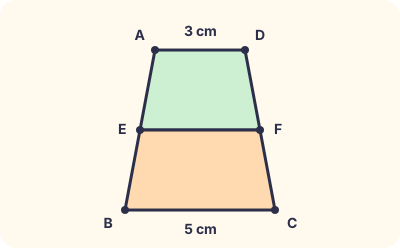
In trapezium ABCD, , cm and cm. E and F are the midpoints of the non-parallel sides. Find the ratio of the area of AEFD to the area of EBCF.
Show the answer
D.
cm. EF cuts the height in half, so both parts have height . Areas: AEFD and EBCF , giving . Traps: compares the bases only; assumes EF splits the area equally; is reversed.
Topics covered
- Tiling with parallelograms
- Defining a quadrilateral
- Convex and non-convex
- Convexity and diagonals
- Opposite angles
- Diagonals
- Angles of a parallelogram
- Opposite angles of a parallelogram
- Sides of a parallelogram
- Diagonals of a parallelogram
- Area of a parallelogram
- Tests for a parallelogram
- Converse of opposite angles
- Proof: diagonals bisect each other
- Equal diagonals
- Recognising a rhombus
- Recognising a kite
- Rhombus: side from diagonals
- Rhombus: area from diagonals
- Angles of a rhombus
- Diagonal of a rectangle
- Diagonals of a rectangle
- Diagonal of a square
- Special parallelograms
- Shapes and their diagonals
- Trapezium: segment joining midpoints
- Trapezium midsegment
- Areas in a trapezium
- Midpoint Theorem
- Triangle of midpoints
- Proof of the Midpoint Theorem
- Named theorems
- Varignon parallelogram
- Centroid Theorem
- Centroid
- Line parallel to the base
- Trisecting a diagonal
- Angle sum of a polygon
- Angle sum of a quadrilateral
- Counting diagonals
- Tiling the plane
- Interior angles of regular polygons
- Tiling with any 4-gon
- Existence of a 4-gon
- Kinds of 4-gons
More CBSE Class 9 Mathematics chapters
- Orienting Yourself: The Use of Coordinates
- Introduction to Linear Polynomials
- The World of Numbers
- Exploring Algebraic Identities
- I’m Up and Down, and Round and Round
- Measuring Space: Perimeter and Area
- The Mathematics of Maybe: Introduction to Probability
- Predicting What Comes Next: Exploring Sequences and Progressions
- Propositions and Their Converses
- How Quantities Combine: Understanding Data
- The World of Algorithms
- Two Variables, One Line
- Math of Space: Surface Area and Volume