I’m Up and Down, and Round and Round: CBSE Class 9 Mathematics practice questions
Practise 50 questions on I’m Up and Down, and Round and Round, free, with an explanation for each answer.
Sample questions
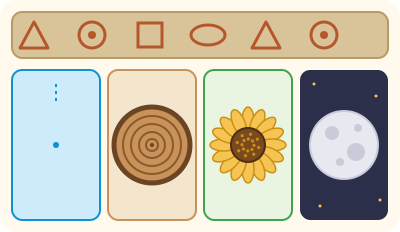
Ripples from a raindrop, the rings of a cut tree trunk, a sunflower head and the full moon all look like circles. Even early rock art shows circles. Which property does every circle have, and is used to define a circle?
- It has no straight edges
- It has exactly one line of symmetry
- Every point on it is the same distance from one fixed point
- Its boundary is exactly twice as long as its width
Show the answer
C. Every point on it is the same distance from one fixed point
Every circle has a centre, and every point on the circle is at the same distance from it; this observation becomes the definition. An oval also has no straight edges, so that cannot define a circle. A circle has infinitely many lines of symmetry, and its boundary is about 3.14 times its width, not twice.
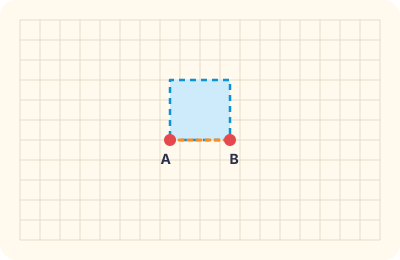
A and B are two points on a plane. How many different squares can be drawn with both A and B as corners (vertices)?
- 1
- 2
- Infinitely many
- 3
Show the answer
D. 3
If AB is a side, the square can be built on either side of AB: 2 squares. If AB is a diagonal, the other two corners are fixed by the perpendicular bisector of AB: 1 square. Total . Infinitely many squares are possible only if A and B merely have to lie somewhere on the boundary.
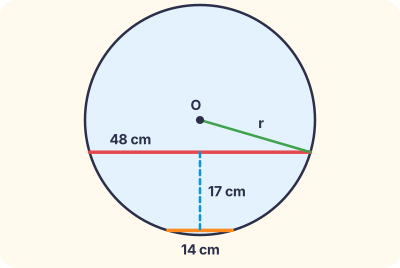
Two parallel chords of 48 cm and 14 cm lie on the same side of the centre of a circle. The chords are 17 cm apart. Find the radius.
- cm
- cm
- cm
- cm
Show the answer
B. cm
, so , giving and . Then cm (check with the shorter chord, cm from the centre: ✓). cm stops at ; cm is half the longer chord; cm adds instead of using squares.
Topics covered
- Circles in nature
- Definition of a circle
- Arcs
- Chords and diameter
- Key terms
- Symmetries of a circle
- Symmetry of shapes
- Circles through two points
- Squares through two points
- Circle through three points
- Collinear points
- Circumcentre
- Circumcentre of a right triangle
- Constructing a circumcircle
- Chord and central angle
- Proof tools
- Centre to midpoint of a chord
- Distance between parallel chords
- Perpendicular bisector of a chord
- Angles subtended by an arc
- Equidistant chords
- Length of a chord
- Distance of a chord
- Radius from a chord
- Chord length formula
- Chord length and distance
- Parallel chords on the same side
- Shortest chord through a point
- Regular hexagon in a circle
- Angle at the centre and on the circle
- Angle subtended by an arc
- Proof of the arc-angle theorem
- Angles in an isosceles triangle with the centre
- Angle in a semicircle
- Angles in the same segment
- Cyclic quadrilateral
- Test for a cyclic quadrilateral
- Reflex angle at the centre
- Exterior angle of a cyclic quadrilateral
- Cyclic parallelograms
- Area of a cyclic quadrilateral
More CBSE Class 9 Mathematics chapters
- Orienting Yourself: The Use of Coordinates
- Introduction to Linear Polynomials
- The World of Numbers
- Exploring Algebraic Identities
- Measuring Space: Perimeter and Area
- The Mathematics of Maybe: Introduction to Probability
- Predicting What Comes Next: Exploring Sequences and Progressions
- Propositions and Their Converses
- How Quantities Combine: Understanding Data
- The World of Algorithms
- Quadrilaterals
- Two Variables, One Line
- Math of Space: Surface Area and Volume