Measuring Space: Perimeter and Area: CBSE Class 9 Mathematics practice questions
Practise 50 questions on Measuring Space: Perimeter and Area, free, with an explanation for each answer.
Sample questions
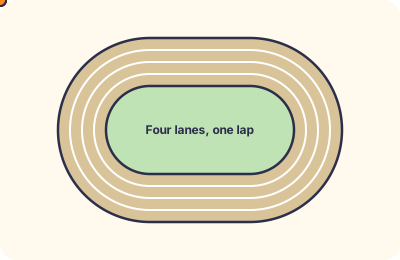
In a 4 × 100 m relay, runners in the outer lanes start a little ahead of runners in the inner lanes. But every lane has the same finish line. Why are the starting points staggered like this?
- Runners in the outer lanes are quicker, so they are given a bonus start
- The finish line is also staggered, so every lane ends at a different spot
- On the bends the outer lanes follow bigger circles, so their path is longer; starting ahead makes every runner cover the same distance
- The outer lanes are wider, so the runners there need extra room at the start
Show the answer
C. On the bends the outer lanes follow bigger circles, so their path is longer; starting ahead makes every runner cover the same distance
On the straight parts all lanes have the same length, but on the bends the outer lanes run along circles of larger radius, and the length of a circle grows with its radius (). The stagger moves the outer starting lines forward by exactly that extra length so that all runners cover the same distance. It is not a reward for speed, the finish line is common to all, and every lane has the same width (1.22 m), so width is not the reason.
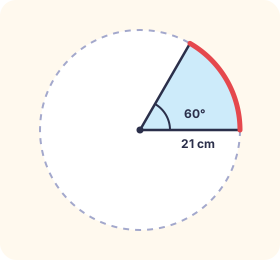
A circle has radius 21 cm. An arc of this circle subtends an angle of at the centre. Taking , what is the length of the arc?
- cm
- cm
- cm
Show the answer
A. cm
Arc length cm. Traps: using instead of (gives ), using the area formula (square units, not a length), or stopping at the full circumference cm.
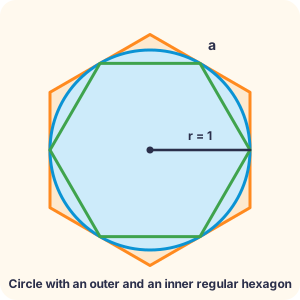
A circle of radius 1 touches all six sides of a regular hexagon (the outer hexagon). Using a right triangle, each side of this hexagon is . By comparing perimeters, what upper bound for do we get?
Show the answer
C.
Outer hexagon: perimeter . The circle lies inside it, so , hence . Traps: forgetting that the circle has perimeter (giving ), using the inner hexagon's perimeter 6 (that gives the lower bound ), or quoting one side .
Topics covered
- Lane stagger
- Perimeter and area of a rectangle
- Estimating the C/D ratio
- Radius from circumference
- Facts about π
- Bounds for π
- Archimedes' hexagon bound
- History of π
- Sizes of estimates of π
- π is irrational
- Length of an arc
- Perimeter of a sector
- Perimeter of a composite shape
- Stagger between lanes
- Lane lengths on a bend
- Perimeter of overlapping circles
- Outline of overlapping circles
- Wheel revolutions
- Perimeter of petals
- Circle formulas with r = 7
- Area of a parallelogram
- Height of a parallelogram
- Parallelogram: sides do not fix the area
- Area of a triangle
- Median of a triangle
- Heron's formula
- Steps of Heron's formula
- Heron's formula with a ratio
- Area of an isosceles trapezium
- Area of a rhombus
- When sides determine the area
- Brahmagupta's formula
- Brahmagupta generalises Heron
- Cyclic 4-gons
- Squaring a rectangle
- Rectangles with a fixed perimeter
- Ancient area rule
- Archimedes' triangle
- Area of a circle from slices
- Area formulas
- Area of a quadrant
- Area swept by a clock hand
- Area of a major sector
- Sector of a circle
- Segment of a circle
- Area of a segment
- Area of a ring
- Polygons inside a circle
More CBSE Class 9 Mathematics chapters
- Orienting Yourself: The Use of Coordinates
- Introduction to Linear Polynomials
- The World of Numbers
- Exploring Algebraic Identities
- I’m Up and Down, and Round and Round
- The Mathematics of Maybe: Introduction to Probability
- Predicting What Comes Next: Exploring Sequences and Progressions
- Propositions and Their Converses
- How Quantities Combine: Understanding Data
- The World of Algorithms
- Quadrilaterals
- Two Variables, One Line
- Math of Space: Surface Area and Volume