How Quantities Combine: Understanding Data: CBSE Class 9 Mathematics practice questions
Practise 50 questions on How Quantities Combine: Understanding Data, free, with an explanation for each answer.
Sample questions
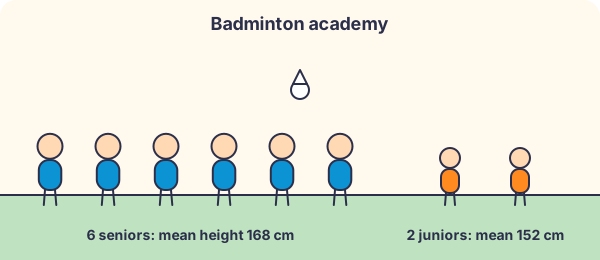
A badminton academy has 6 seniors and 2 juniors. The mean height of the seniors is and of the juniors is . What is the mean height of all 8 players together?
Show the answer
B.
Each group total is mean size: and . Combined mean . The trap is the average of averages, , which treats the 2 juniors as if they were as many as the 6 seniors. Swapping the weights gives , and dividing by 2 groups instead of 8 players gives .
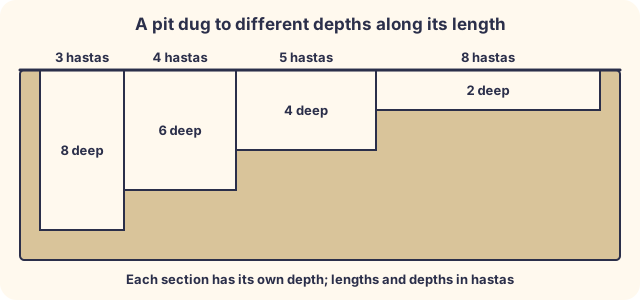
This is Brahmagupta’s idea of mean depth. A pit 20 hastas long is dug in four sections. The sections are 3, 4, 5 and 8 hastas long. They are dug to depths of 8, 6, 4 and 2 hastas respectively. What is the mean depth of the pit?
- 5 hastas
- 21 hastas
- 4.2 hastas
- 84 hastas
Show the answer
C. 4.2 hastas
Mean depth . The plain mean of depths gives the long shallow section too little say. Dividing by 4 sections gives , and forgetting to divide at all gives .
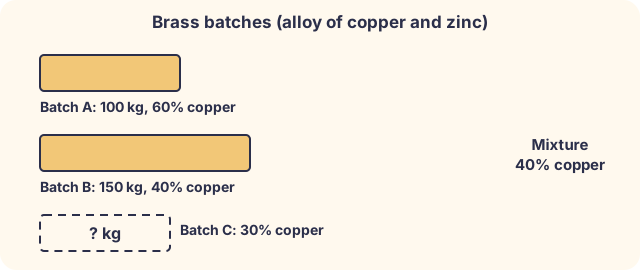
Brass batch A weighs 100 kg and is 60% copper. Batch B weighs 150 kg and is 40% copper. Batch C is 30% copper. When all three are melted together the alloy is 40% copper. What is the weight of Batch C?
- 200 kg
- 20 kg
- 100 kg
- 250 kg
Show the answer
A. 200 kg
. So , i.e. , giving and . Stopping at (not dividing by 0.1) gives the trap , and is just the weight of A and B together. Check: copper in is .
Topics covered
- Average of averages
- Weighted mean on a number line
- When the simple mean works
- Equal-sized groups
- Mixtures
- Mixtures: unknown weight
- Mean depth of a pit
- Equal quantities
- Weighted mean: gold purity
- Expression for combined mean
- Mixtures of three
- Weight times value
- Custom weights
- Marks out of different totals
- Ratings with weights
- Weights by recency
- Profit percentage
- Adding one value to a mean
- Two-level weighted mean
- Balance point of a weighted mean
- Find the number in a group
- Adding a value to a group
- Mixing salty water
- Range of a mixture
- Diluting a mixture
- Reading a cluster-column chart
- Reading a stacked bar chart
- Share of a total
- 100% stacked bar chart
- Inferences from a 100% stacked chart
- Stacked vs 100% stacked
- Averages hide differences
- 100% stacked bar: shares
- Making a 100% stacked bar
- Run rate as a mean
- Average price of shares
- Mean price after a purchase
- Equal weights give the midpoint
- Doubling the weights
- Shares that change
- 100% bar from times
- Key terms
- What acts as the weight
- Choosing a chart
- Mixture concentrations
- Effect on the mean
- Combining two groups
- Sorting mixtures
- History of the weighted mean
- Ranking by weighted score
More CBSE Class 9 Mathematics chapters
- Orienting Yourself: The Use of Coordinates
- Introduction to Linear Polynomials
- The World of Numbers
- Exploring Algebraic Identities
- I’m Up and Down, and Round and Round
- Measuring Space: Perimeter and Area
- The Mathematics of Maybe: Introduction to Probability
- Predicting What Comes Next: Exploring Sequences and Progressions
- Propositions and Their Converses
- The World of Algorithms
- Quadrilaterals
- Two Variables, One Line
- Math of Space: Surface Area and Volume