The Mathematics of Maybe: Introduction to Probability: CBSE Class 9 Mathematics practice questions
Practise 50 questions on The Mathematics of Maybe: Introduction to Probability, free, with an explanation for each answer.
Sample questions
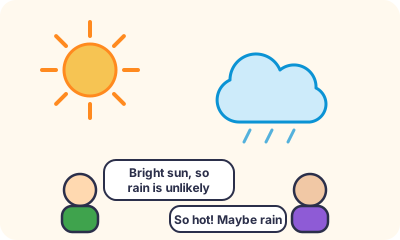
Two friends look at the same sky. Asha says, “It is bright and sunny, so rain is unlikely.” Ravi says, “It is very hot, so I think it may rain later.” Each of them judges the chance of rain only from what they see. They do not count trials or equal outcomes. What kind of probability are they giving?
- Theoretical probability, because all outcomes are equally likely
- Experimental probability, because they repeated an experiment many times
- Subjective probability, a personal judgement based on the evidence they see
- A probability of exactly , because it either rains or it does not
Show the answer
C. Subjective probability, a personal judgement based on the evidence they see
Estimates based on how a person reads the situation are subjective probability. Rain is not an equally likely two-outcome event, so the idea that "rain or no rain" must be is a common slip. Experimental and theoretical probability need repeated trials or equally likely outcomes, which neither friend used.
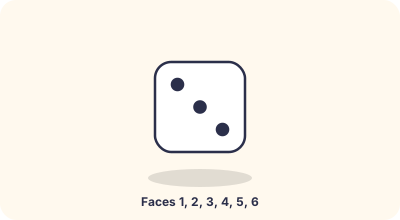
A fair die is rolled 6000 times. About how many times would you expect a 4 to appear?
- About times
- About times
- About times
- About times
Show the answer
B. About times
For a fair die , and in the long run the share of 4s gets close to this (the Law of Large Numbers). Expected count . Dividing 6000 by 4 gives , and would come from reusing the experimental from only 50 rolls.
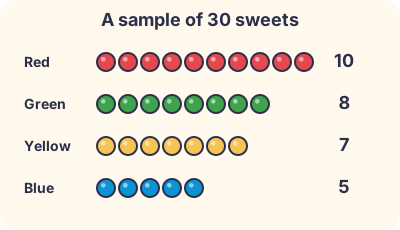
A teacher picks a sample of 30 sweets from a large bag of 600 sweets. The sample has 10 red, 8 green, 7 yellow and 5 blue. Based on the sample, about how many yellow sweets are in the whole bag?
Show the answer
A.
, so the estimate is . Using the blue count gives , using red gives , and dividing ignores the sample size of 30.
Topics covered
- Subjective probability
- Probability scale
- Theoretical probability
- Range of probability
- Experimental probability
- Experimental vs theoretical
- Law of Large Numbers
- Statistical probability
- Estimating from a sample
- Sampling
- Events on a spinner
- Gambler's fallacy
- Fair coin
- Sample space
- Equally likely outcomes
- Key terms
- Sample space and events
- Sample space of two dice
- Impossible events
- Probability with area
- Tree diagrams
- Events
- Events as subsets
More CBSE Class 9 Mathematics chapters
- Orienting Yourself: The Use of Coordinates
- Introduction to Linear Polynomials
- The World of Numbers
- Exploring Algebraic Identities
- I’m Up and Down, and Round and Round
- Measuring Space: Perimeter and Area
- Predicting What Comes Next: Exploring Sequences and Progressions
- Propositions and Their Converses
- How Quantities Combine: Understanding Data
- The World of Algorithms
- Quadrilaterals
- Two Variables, One Line
- Math of Space: Surface Area and Volume