Propositions and Their Converses: CBSE Class 9 Mathematics practice questions
Practise 50 questions on Propositions and Their Converses, free, with an explanation for each answer.
Sample questions
Which of these is a proposition? (A proposition is a statement that is definitely either true or false.)

- Please sit down quietly.
- A triangle can have two right angles.
- How tall is this triangle?
- What a lovely drawing!
Show the answer
B. A triangle can have two right angles.
A proposition is a statement that is either true or false. "A triangle can have two right angles" is a proposition because it can be judged: it is false, since the angle sum would exceed . A request, a question and an exclamation cannot be called true or false, so they are not propositions.
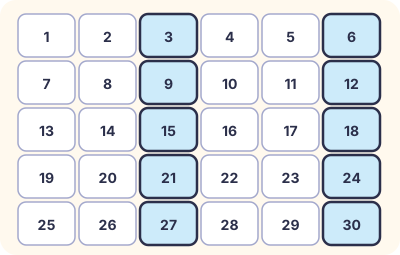
Q: If a number is a multiple of 3, then it is a multiple of 6. How many numbers from 1 to 30 are counterexamples to Q?
- 10
- 15
- 5
- 25
Show the answer
C. 5
Multiples of 3 up to 30: , which is 10 numbers. Multiples of 6: , which is 5 numbers. Counterexamples are multiples of 3 that are not multiples of 6: , so . The trap 10 counts every multiple of 3; 25 counts all numbers that are not multiples of 6.
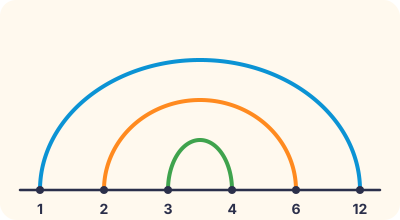
For a number , pair each factor with its 'partner' (the factor that multiplies with it to give ). The argument says: if there is an odd number of factors, there must be a pair , so . What does this argument prove?
- Only Q: if has an odd number of factors, then is a perfect square.
- Only P: if is a perfect square, then it has an odd number of factors.
- Both P and its converse Q.
- Neither P nor Q.
Show the answer
A. Only Q: if has an odd number of factors, then is a perfect square.
The argument starts with 'an odd number of factors' and ends with 'a perfect square', so it proves Q only. It does not show that every square has an odd number of factors, because a square could in principle have several repeated pairs. P needs the extra fact that a number has at most one pair .
Topics covered
- Propositions
- Converse of a proposition
- Using a true proposition
- Proof of the converse
- The proof's altitude
- Example 1: rain and the road
- Counterexamples
- Converse of a true statement
- Counterexamples and Fermat
- Example 2: multiples of 6 and 3
- Finding a counterexample
- Example 3: factor-partner argument
- Factor pairs of 36
- Odd number of factors
- Proving Q in Example 3
- Example 4: same area
- Four possible outcomes
- Exercise 8: divisibility
- Example 5: converse of the Pythagoras theorem
- Proof of the converse of Pythagoras
- The right angle in the proof
- Using the converse
- Which angle is a right angle?
- Understanding converses
- Writing a converse
- Exercise 1: parallel lines
- Exercise 2: square and angles
- Exercise 3: incentre figure
- Reading Fig. 9.1
- Converse of the incentre statement
- Exercise 5: products of squares
- Exercise 6: squares of numbers
- Exercises 4 to 9: converses
- Exercise 8: smallest counterexample
- Exercise 10: exactly 3 factors
- Exercise 11: four divisors
- Exercise 11: converse
- Exercise 12: converse
- Exercise 13(ii): neat expressions
- Exercises 13 and 14: counterexamples
- Exercise 15: divisible by 8
- Exercise 16: divisibility by 3
- Exercise 17(i): equal diagonals
- Exercise 17(ii): converse property
- Squares and rectangles
- Propositions and their converses
- Key terms
- Disproving a claim
- False propositions and converses
- Fermat and Euler
More CBSE Class 9 Mathematics chapters
- Orienting Yourself: The Use of Coordinates
- Introduction to Linear Polynomials
- The World of Numbers
- Exploring Algebraic Identities
- I’m Up and Down, and Round and Round
- Measuring Space: Perimeter and Area
- The Mathematics of Maybe: Introduction to Probability
- Predicting What Comes Next: Exploring Sequences and Progressions
- How Quantities Combine: Understanding Data
- The World of Algorithms
- Quadrilaterals
- Two Variables, One Line
- Math of Space: Surface Area and Volume