Exploring Algebraic Identities: CBSE Class 9 Mathematics practice questions
Practise 50 questions on Exploring Algebraic Identities, free, with an explanation for each answer.
Sample questions
Use the area model to expand .
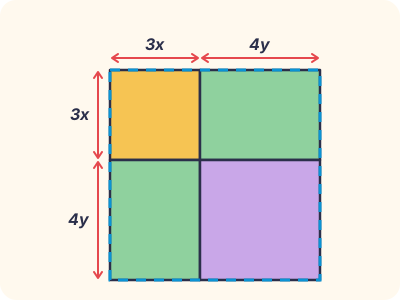
Show the answer
D.
. Leaving out the two rectangles gives ; forgetting the 2 gives ; and comes from not squaring the coefficient 3.
Find by writing and using .
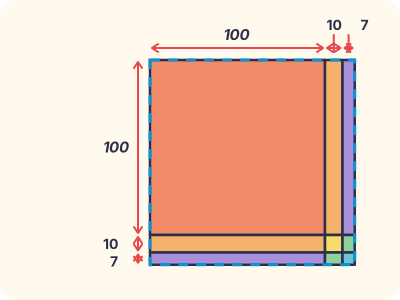
- 10149
- 11919
- 10289
- 13689
Show the answer
D. 13689
. drops all the rectangles, forgets to double them, and uses the trap .
Expand .
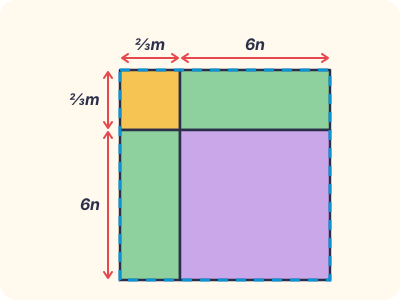
Show the answer
B.
. Dropping the middle term or forgetting its 2 gives the wrong options, and comes from not squaring the coefficients.
Topics covered
- Area model of (a + b)²
- Area model of (a − b)²
- Why (a − b)² ends in + b²
- Area model of (a + b + c)²
- Algebra tiles: (x + 3)(x + 4)
- Algebra tiles: (2x + 3)(3x + 1)
- Splitting the middle term
- Cube of edge (a + b)
- Area of a path
- Standard identities
- Pieces of the cube (a + b)³
- Factorising x² + bx + c
- Mental maths with identities
- Three consecutive squares
- Visualising (a − b)²
- Comparing (a + b)², a² + b², (a − b)² and a² − b²
- Simplifying rational expressions
- Square of a trinomial
- Identity or equation?
- Factors of x⁴ − y⁴
- n³ − n is divisible by 6
- Identities hold for all numbers
- Equivalent forms of (a − b)²
- Number plus its reciprocal
- When is (a + b)² smaller than a² + b²?
- Expanding (a + b)²
- Expanding with fractions
- Combining identities
- Squaring numbers with (a − b)²
- Squaring numbers with (a + b + c)²
- Products with (a + b)(a − b)
- Four consecutive squares
- Śrīdharāchārya's method
- Cubing numbers with (a − b)³
- Factorising with a common factor
- Factorising a square of three terms
- Using (a + b)³
- Sum of two cubes
- x³ + y³ + z³ − 3xyz
- Sum of cubes of three numbers
- Length and breadth from area
- Algebra tiles: factorising
More CBSE Class 9 Mathematics chapters
- Orienting Yourself: The Use of Coordinates
- Introduction to Linear Polynomials
- The World of Numbers
- I’m Up and Down, and Round and Round
- Measuring Space: Perimeter and Area
- The Mathematics of Maybe: Introduction to Probability
- Predicting What Comes Next: Exploring Sequences and Progressions
- Propositions and Their Converses
- How Quantities Combine: Understanding Data
- The World of Algorithms
- Quadrilaterals
- Two Variables, One Line
- Math of Space: Surface Area and Volume