Orienting Yourself: The Use of Coordinates: CBSE Class 9 Mathematics practice questions
Practise 50 questions on Orienting Yourself: The Use of Coordinates, free, with an explanation for each answer.
Sample questions
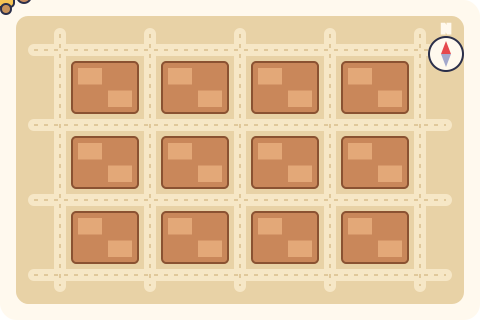
A city of the Sindhu-Sarasvatī Civilisation was built like a grid, with streets running North–South and East–West at regular gaps. Roughly how far apart were these streets?
- About 1 m
- About 10 m
- About 100 m
- About 1 km
Show the answer
B. About 10 m
The streets were laid out with striking precision in North–South and East–West directions, about 10 metres apart. A merchant could find a shop by counting units of distance North–South and East–West from the city centre — a coordinate system in practice.
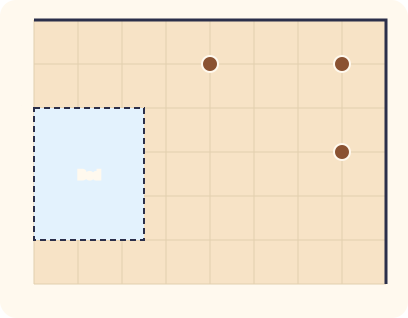
Using the feet , and of the study table (1 unit = 1 ft), what can you say about the table's size?
- 11 ft long and 9 ft wide; its height cannot be read from the plan
- 19 ft long and 16 ft wide; its height cannot be read from the plan
- 3 ft long and 2 ft wide; its height cannot be read from the plan
- 3 ft long, 2 ft wide and 9 ft high
Show the answer
C. 3 ft long and 2 ft wide; its height cannot be read from the plan
Length ft and width ft. A floor plan is 2-D, so the height cannot be found from it. Reading a single coordinate (11 ft, 9 ft), adding coordinates (19 ft, 16 ft) or treating a y-coordinate as height are all mistakes.
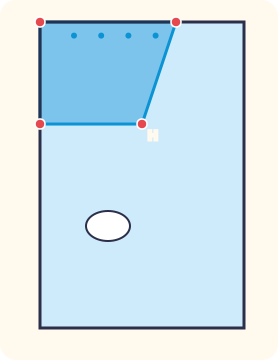
The showering area SHWR in Reiaan's bathroom has corners , , and (1 unit = 1 ft). What is its floor area?
- 21 sq ft
- 12 sq ft
- 9 sq ft
- 10.5 sq ft
Show the answer
D. 10.5 sq ft
SH and RW lie on and , so they are parallel and SHWR is a trapezium. ft, ft and the height is ft. 21 forgets the ; 12 treats it as a rectangle; 9 as a square.
Topics covered
- Grids in history
- Floor plan of Reiaan's room
- Distances along the axes
- Reading a plan
- Completing a rectangle
- Lengths on a plan
- Coordinates in Quadrant II
- Area of the showering area
- Door swing and clearance
- Placing a table at the centre
- Plotting points
- Points on the axes
- Quadrants
- Writing coordinates
- Order of coordinates
- Quadrants and signs
- Lines parallel to the axes
- Reading coordinates
- Plotting a quadrilateral
- Why negative numbers matter
- Reflection in an axis
- Reflection preserves length
- Finding a distance
- Distance formula
- Distance with negative coordinates
- Distance from the origin
- Right triangle on the plane
- Special triangles
- Points on a circle
- Inside, on or outside a circle
- Checking collinearity
- Midpoints
- Points of trisection
- Triangle from its midpoints
- City street model
- Coordinates on a screen
- Square on the plane
More CBSE Class 9 Mathematics chapters
- Introduction to Linear Polynomials
- The World of Numbers
- Exploring Algebraic Identities
- I’m Up and Down, and Round and Round
- Measuring Space: Perimeter and Area
- The Mathematics of Maybe: Introduction to Probability
- Predicting What Comes Next: Exploring Sequences and Progressions
- Propositions and Their Converses
- How Quantities Combine: Understanding Data
- The World of Algorithms
- Quadrilaterals
- Two Variables, One Line
- Math of Space: Surface Area and Volume