Some Applications of Trigonometry: CBSE Class 10 Mathematics practice questions
Practise 50 questions on Some Applications of Trigonometry, free, with an explanation for each answer.
Sample questions
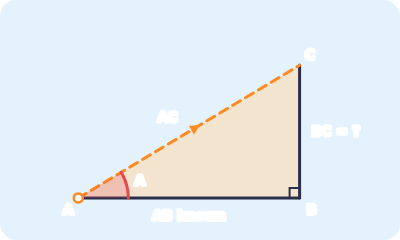
In the right triangle , the horizontal distance is known. We need to find the height . Which ratios of use both and ?
- or
- or
- or
- Only
Show the answer
A. or
is opposite to and is adjacent, so and . Sine and cosine need the hypotenuse , and so do secant and cosecant, so they do not link the two known sides.
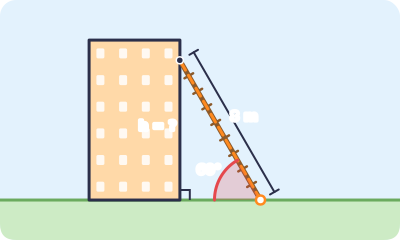
An 8 m long ladder leans against a vertical wall. It makes an angle of with the ground. How high up the wall does it reach?
- m
- m
- m
- m
Show the answer
B. m
The ladder is the hypotenuse and the height is opposite the angle, so and m. Using cosine gives m (the distance of the foot), tangent gives m, and cotangent gives m, each using the wrong sides.
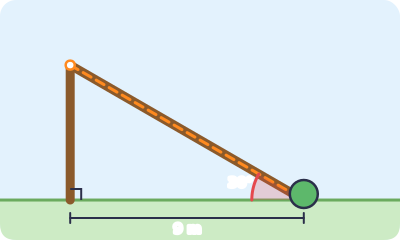
A tree is broken by a storm. The broken part bends, and its top touches the ground 9 m from the foot of the tree. The broken part makes an angle of with the ground. What was the original height of the tree?
- m
- m
- m
- m
Show the answer
A. m
Standing part: gives m. Broken part (hypotenuse): gives m. Original height m. The options and give only one of the two parts, and 9 is just the distance on the ground.
Topics covered
- Line of sight
- Angle of elevation
- Angle of depression
- Alternate angles
- Setting up the problem
- Choosing the ratio
- Height from distance
- Sides of the right triangle
- Ladder problems
- Key terms
- Using sine
- Quick calculations
- Broken tree
- Method
- Sun's altitude
- Building and flagstaff
- Shadow lengths
- Shadow problem
- Two shadows
- Angle from the distance
- Walking towards a building
- Walking towards a tower
- Two buildings
- River width
- Tower and building
- Heights from angles
- Two poles
- Distance from the tower
- Cable tower
- Elevation or depression
- Two ships
- Distance between ships
- Balloon
- Choosing a ratio
- Enough information
- Car approaching a tower
- Shadow problem solution
- Kite string
- Choosing sine, cosine or tangent
- Ladder facts
- Angles of elevation