Real Numbers: CBSE Class 10 Mathematics practice questions
Practise 50 questions on Real Numbers, free, with an explanation for each answer.
Sample questions
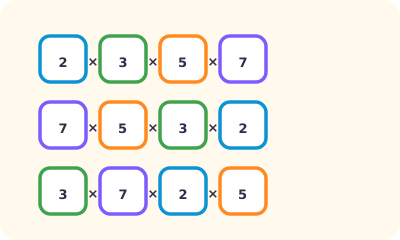
The tiles show written in three different orders. Which statement is the Fundamental Theorem of Arithmetic?
- Every natural number can be written as a product of primes in several different ways
- Every composite number is a product of primes, but each different order gives a different factorisation
- Every composite number is a product of distinct primes, each used only once
- Every composite number can be written as a product of primes, and this factorisation is unique apart from the order of the primes
Show the answer
D. Every composite number can be written as a product of primes, and this factorisation is unique apart from the order of the primes
The theorem has two parts: a composite number can be factorised into primes, and the factorisation is unique except for the order of the factors. The three rows show the same primes in different orders, so they count as one factorisation. Primes may repeat (for example ), so the last option is false.
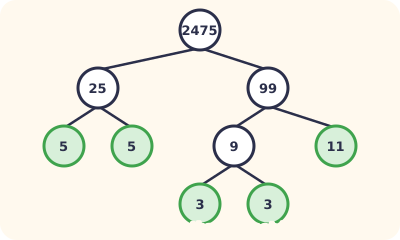
Using the factor tree, write as a product of powers of primes.
Show the answer
A.
The leaves are . Grouping equal primes: (check: ). Writing each prime once gives only 165, using one 5 gives 495, and squaring 11 gives . Every exponent must match how often the prime appears.
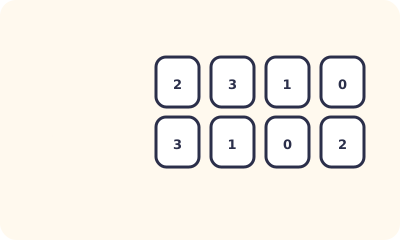
Use the prime powers in the table to find .
- 52920
- 635040
- 7560
- 12
Show the answer
A. 52920
and . Greatest powers: , so . Using gives 7560, the product counts the shared factor 12 twice, and is the HCF.
Topics covered
- Euclid's division
- Fundamental Theorem of Arithmetic
- Prime factorisation
- Factor trees
- Primes and composites
- Composite numbers
- Applications of the theorem
- HCF and LCM
- HCF by prime factorisation
- HCF and LCM relation
- LCM of three numbers
- HCF and LCM of three numbers
- LCM by prime factorisation
- Word problem: meeting again
- Word problem: bells
- Word problem: tiles
- Word problem: equal pieces
- Word problem: same remainder
- HCF
- Decimal expansions
- Theorem 1.2
- Rational and irrational numbers
- Irrationality of √3
- Irrationality of √7
- Irrationality of √2
- Irrationality of √5
- Locating √2
- Irrational numbers on the number line
- Irrational numbers
- Operations with irrational numbers