Polynomials: CBSE Class 10 Mathematics practice questions
Practise 50 questions on Polynomials, free, with an explanation for each answer.
Sample questions
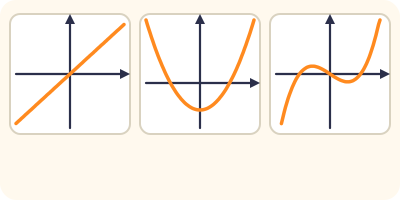
Which of the following is a quadratic polynomial in ?
Show the answer
C.
A quadratic polynomial has degree 2, i.e. it has the form with . has highest power 2, so it qualifies (the order of the terms does not matter). is cubic, is linear, and is not even a polynomial because has a negative power.
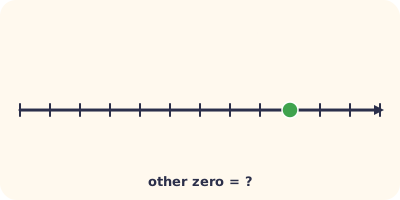
is a zero of . What is the other zero?
Show the answer
A.
Sum of zeroes , so the other zero is . Check with the product: . Slips: ignores the sign of the product, just negates the given zero, and stops at the sum without subtracting . Direct check: .
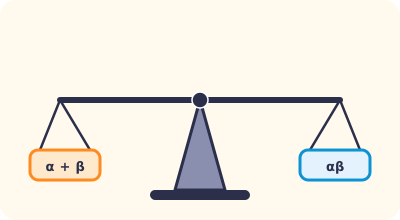
The sum of the zeroes of is equal to their product. Find .
Show the answer
C.
Sum and product . Setting them equal: , so . Slips: drops the minus sign of the sum; comes from inverting wrongly ( instead of ); and makes both slips at once.
Topics covered
- Types of polynomials
- Degree of a polynomial
- Value of a polynomial
- Zero of a linear polynomial
- Zeroes and factors
- Zeroes from a graph
- Graph of a quadratic
- Graph of a cubic
- Sum of zeroes
- Product of zeroes
- Forming a quadratic
- Finding an unknown coefficient
- Zeroes and coefficients
- Expressions in the zeroes
- Cubic polynomial relations
- Forming a cubic
- Zeroes in real life
- Zero from a graph
- Zeroes of a quadratic
- Zeroes of a cubic
- Quadratic with one zero
- Degree and terms
- Number of zeroes
- Zeroes from a table
- Polynomial or not?
- Quadratic polynomials
- Splitting the middle term
- Proof of the relations
- Values of a polynomial
- Quadratic with no zero
- Maximum number of zeroes
- Relations between zeroes and coefficients
- Zeroes of quadratics
- Graphs and number of zeroes
- Sum and product of zeroes