Introduction to Trigonometry: CBSE Class 10 Mathematics practice questions
Practise 50 questions on Introduction to Trigonometry, free, with an explanation for each answer.
Sample questions
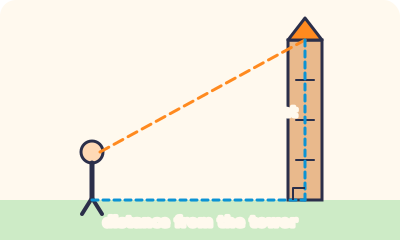
A student looks at the top of a tower. We can imagine a right triangle between the student, the foot of the tower and its top. The branch of mathematics that lets us find the height without measuring it is called trigonometry. The word comes from the Greek words tri, gon and metron. What do they mean?
- triangle, angle, distance
- three, angles, height
- three, sides, measure
- right, side, measure
Show the answer
C. three, sides, measure
Tri = three, gon = sides and metron = measure, so trigonometry literally means "measuring three-sided figures". It studies the relationships between the sides and angles of a triangle, which is exactly what lets us find the height of the tower from the distance and the angle of sight.
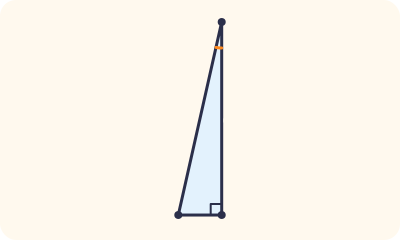
In , right-angled at B, cm, cm and cm. Find .
Show the answer
D.
The side opposite is , so . The trap is to reuse the answer for : is (which is also ). is and is .
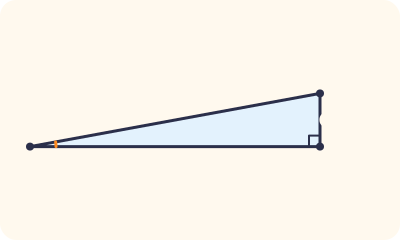
In , right-angled at , cm and cm. Find .
Show the answer
D.
gives , so cm and cm. Then . is . Using instead of gives and the false , and comes from taking the hypotenuse as and then adding again for .
Topics covered
- Introduction
- Trigonometric ratios
- Ratios of specific angles
- Trigonometric identities