Probability: CBSE Class 10 Mathematics practice questions
Practise 50 questions on Probability, free, with an explanation for each answer.
Sample questions
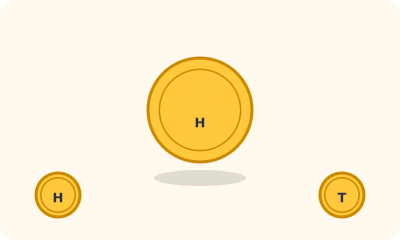
A fair coin is tossed once at random. What is the probability of getting a head?
Show the answer
B.
A fair coin has two equally likely outcomes, head and tail, and one of them is a head, so . Wrong choices come from slips such as counting the edge as a third outcome (), thinking a head is certain (), or confusing it with two coins ().
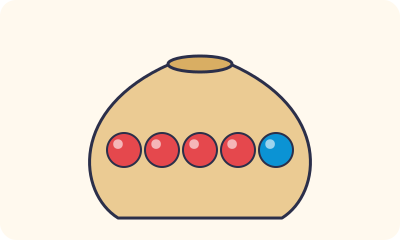
A bag contains 4 red balls and 1 blue ball of the same size. One ball is drawn without looking. Which statement is correct?
- The outcomes "a red ball" and "a blue ball" are not equally likely, because there are more red balls
- The outcomes "a red ball" and "a blue ball" are equally likely, because there are only two colours
- The outcomes "a red ball" and "a blue ball" are equally likely, because the balls are the same size
- A blue ball is more likely, because it is the only one of its colour
Show the answer
A. The outcomes "a red ball" and "a blue ball" are not equally likely, because there are more red balls
There are 5 balls and each ball is equally likely to be drawn, but the colours are not: 4 balls are red and only 1 is blue, so red is more likely. Having two colours does not make them equally likely, and the size of the balls only ensures each ball has the same chance. This is why not every experiment has equally likely outcomes.
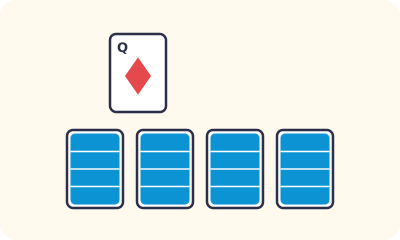
The ten, jack, queen, king and ace of diamonds are shuffled well and placed face down. One card is picked. It is the queen, and it is put aside. What is the probability that the next card picked is an ace?
Show the answer
D.
After the queen is set aside, cards remain and exactly one is the ace, so . Using forgets that the total has fallen to , miscounts the cards left, and is .
Topics covered
- Equally likely outcomes
- Theoretical probability
- Sure and impossible events
- Complementary events
- Probability of an event
- Playing cards
- Tossing coins
- Spinners
- Two dice
- Properties of probability