Quadratic Equations: CBSE Class 10 Mathematics practice questions
Practise 50 questions on Quadratic Equations, free, with an explanation for each answer.
Sample questions
In the equation , , and are real numbers. Which condition must be true for it to be a quadratic equation?
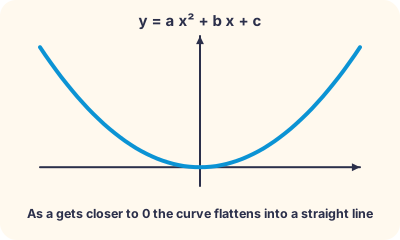
- , and are all non-zero
Show the answer
C.
The equation is quadratic because of the term. If that term vanishes and only is left, a linear equation (the picture's curve flattens to a line). or can be zero: () and () are both quadratic, so the other conditions are not needed.
First simplify, then decide. Which one of these is a quadratic equation?
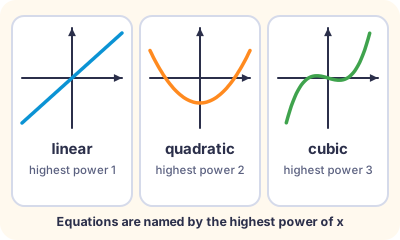
Show the answer
B.
, so becomes : it looks cubic but is quadratic. In the others the (or ) terms cancel: gives ; gives ; gives . All three are linear.
A train travels 480 km at a uniform (constant) speed. If its speed were 8 km/h less, it would take 3 hours more for the same journey. What is the usual speed of the train?
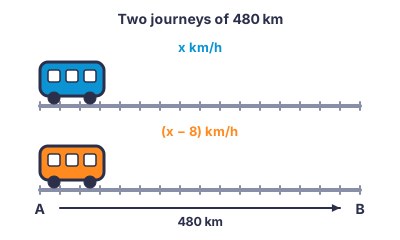
- 40 km/h
- 32 km/h
- 48 km/h
- 160 km/h
Show the answer
A. 40 km/h
Let the speed be km/h. Then , which simplifies to , i.e. . The speed cannot be negative, so km/h (times: 12 h and 15 h, a difference of 3 h). 32 is the reduced speed, 48 is , and 160 is , which ignores the equation.
Topics covered
- Standard form
- Quadratic equation
- Forming equations
- Roots of a quadratic equation
- Roots and zeroes
- Solution by factorisation
- Roots and graphs
- Nature of roots
- Word problems
- Number of roots
- Is it quadratic?
- Roots of equations
- Is the situation possible?
- Discriminant
- Pole in the park
- Quadratic formula
- History of quadratic equations