Pair of Linear Equations in Two Variables: CBSE Class 10 Mathematics practice questions
Practise 50 questions on Pair of Linear Equations in Two Variables, free, with an explanation for each answer.
Sample questions
Akhila spent ₹20 at a village fair. A Giant Wheel ride costs ₹3 and a game of Hoopla costs ₹4. The number of Hoopla games she played is half the number of rides. Let be the number of rides and the number of games. Which pair of equations shows this?

- and
- and
- and
- and
Show the answer
C. and
Games are half of rides, so . Each ride costs ₹3 and each game ₹4, so the money is . Swapping the letters in the first equation () says rides are half the games, swapping the prices gives , and treats the number of rides plus games as the money spent. The correct pair has the solution : .
The table compares the coefficients of and . What do the lines of this pair do?

- They intersect at exactly one point
- They coincide
- They are perpendicular
- They are parallel
Show the answer
D. They are parallel
, and . When the lines are parallel and the pair has no solution. Intersection would need , coincidence needs all three ratios equal, and "perpendicular" is not decided by these ratios.
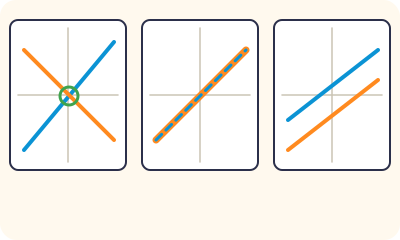
The pair and has infinitely many solutions. Find .
Show the answer
A.
Coincident lines need . So and . Adding gives , so (and ). Using by a sign slip gives , is the value of , and is only .
Topics covered
- Forming equations
- Graphical method
- Consistent and inconsistent pairs
- Reading the ratio condition
- Coincident lines
- Comparing ratios
- Finding k
- Finding unknown coefficients
- Graphs and areas
- Intercepts
- Forming and solving
- Forming equations from a story
- Substitution method
- Age problems
- Solving word problems
- Elimination method
- Digit problems
- Fixed and variable charges
- Fractions
- Money problems
- Reading solutions from a graph
- Parallel lines
- Angle problems
- Condition for a unique solution
- No-solution condition
- Dependent pairs
- Ratios and graphs
- Nature of a pair
- Key terms
- Types of pairs
- Consistent pairs
- Points on a line
- Operations on equations
- Rails that never meet
- Number of solutions