Work, Energy, and Simple Machines: CBSE Class 9 Physics practice questions
Practise 50 questions on Work, Energy, and Simple Machines, free, with an explanation for each answer.
Sample questions
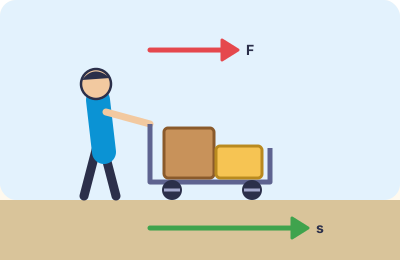
Arjun pushes a loaded trolley with a steady horizontal force of . It moves in the direction of his push. How much work does Arjun do on the trolley?
Show the answer
B.
Work done with in metres: , so . Using 400 straight from centimetres gives the trap answer . comes from dividing force by distance, and from adding them.
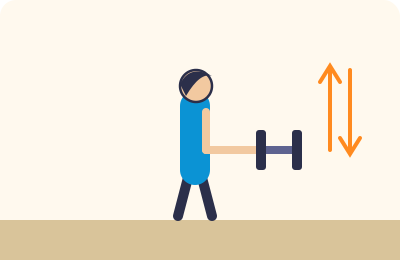
A girl lifts a dumbbell up and then lowers it slowly. While she is lowering it, what work does her force do on the dumbbell?
- Positive, because she is applying a force
- Zero, because she moves it slowly
- It depends only on the mass of the dumbbell
- Negative, because the dumbbell moves opposite to her upward force
Show the answer
D. Negative, because the dumbbell moves opposite to her upward force
While lowering it slowly, she still pushes upwards (about equal to its weight), but the dumbbell moves downwards. The force and displacement are opposite, so her work on it is negative. While raising it, force and displacement are in the same direction, so that work is positive. The work is not zero, because the dumbbell does move.
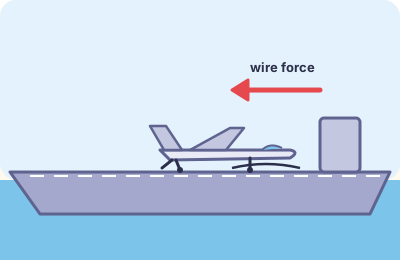
A jet lands on a ship's deck. A strong wire on the deck (an arresting wire) catches it and pulls back on it with a steady force of . The jet stops in . How fast was the jet moving when the wire caught it?
Show the answer
A.
Work by the wire . By the work-energy theorem this equals , so and (216 km/h). Forgetting the gives , about . Forgetting the square root gives 3600, and making both slips gives 1800.
Topics covered
- Work done by a constant force
- Zero work done
- Force perpendicular to displacement
- Positive and negative work
- Work from a force–displacement graph
- Work-energy theorem
- Ways of transferring energy
- Forms of energy
- Energy transformations
- Kinetic energy
- Potential energy
- Work and energy basics
- Gravitational potential energy
- Kinetic and potential energy
- Conservation of mechanical energy
- Formulas and units
- Work and kinetic energy
- Power
- Pulley
- Inclined plane
- Lever
- Classes of levers
- Simple machines and work
- Energy conversion
- Simple machines and energy