How Forces Affect Motion: CBSE Class 9 Physics practice questions
Practise 50 questions on How Forces Affect Motion, free, with an explanation for each answer.
Sample questions
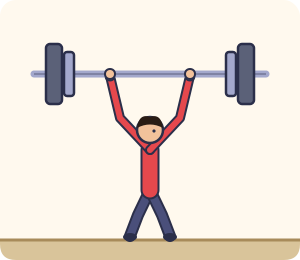
A weightlifter holds a barbell steady above her head. The bar has a mass of 20 kg and a 15 kg plate is fixed on each side. What upward force must she apply? (Take .)
- 343 N
- 50 N
- 196 N
- 490 N
Show the answer
D. 490 N
Total mass . Weight downwards. To keep the barbell steady the forces must be balanced, so she pushes 490 N upwards. 343 N counts only one plate, 196 N counts only the bar, and 50 N is the mass, not a force.
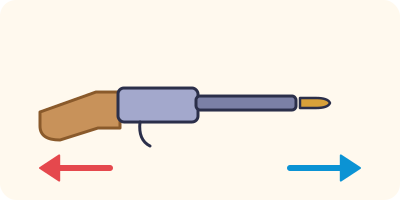
A gun of mass 4 kg fires a bullet of mass 50 g with a force of 6 N. What is the initial acceleration of the bullet?
Show the answer
C.
, so . By Newton's third law the bullet pushes the gun back with the same 6 N, giving the gun only (that option is the gun's value). Equal forces, unequal masses, so unequal accelerations. 0.12 comes from using 50 kg, and 0.3 from multiplying force by mass.
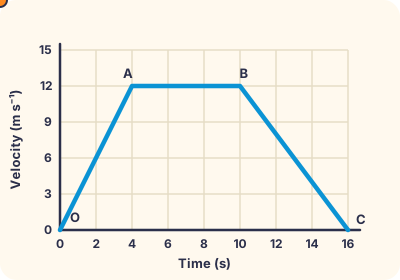
The same 1200 kg car is moving towards the east. What net force acts on it from B to C (10 s to 16 s)?
- 2400 N towards the east
- 1440 N towards the west
- 2400 N towards the west
- Zero, because the car is coming to rest
Show the answer
C. 2400 N towards the west
, , , so . The minus sign means the force acts opposite to the motion, i.e. towards the west. 'East' is the sign slip, 1440 N uses s read off the axis instead of the 6 s interval, and the car is slowing down, so the force is not zero.
Topics covered
- Forces on a pushed object
- Force of friction
- Newton's first law and graphs
- Newton's second law and graphs
- Rocket propulsion
- Friction helps motion
- System of objects
- Force from a velocity–time graph
- Weight and balanced forces
- Net force and motion
- Recoil of a gun
- Net force
- Stopping force
- Force and time of contact
- Friction and stopping distance
- Second law: mass and acceleration
- Forces in the same direction
- Activity: force and acceleration
- Momentum
- Inertia
- Newton's third law
- Activity: verifying the third law
- Second law: force, mass and acceleration
- Rocket propulsion in space
- Measuring friction
- Balanced and unbalanced forces
- Third law and unequal masses
- Bridging Science and Society: safety
- Newton's first law
- Stopping time and force
- Increasing and reducing friction
- Ready to Go Beyond
- Newton's three laws
- Net force and velocity
- Third law for all forces
- Action and reaction
- Size of forces
- Activity: friction on different surfaces
- Activity: balloon rocket