Sound Waves: Characteristics and Applications: CBSE Class 9 Physics practice questions
Practise 50 questions on Sound Waves: Characteristics and Applications, free, with an explanation for each answer.
Sample questions
In a science-fiction film, a spacecraft explodes far out in space. The astronaut watching sees the flash and hears a loud bang at the same moment. What is wrong with this scene?

- Nothing is wrong: light and sound both travel through space at the same speed
- The bang should be heard first, because sound travels faster than light
- No bang should be heard at all, because space is almost a vacuum and sound needs a medium
- The bang should be heard a few seconds after the flash, as thunder follows lightning
Show the answer
C. No bang should be heard at all, because space is almost a vacuum and sound needs a medium
Outer space is almost a vacuum, and sound is a mechanical wave, so it cannot travel there. The astronaut would see the flash, because light needs no medium, but would hear nothing. Option d would be correct on the Earth, where sound travels through air far more slowly than light. Astronauts on a spacewalk talk to each other through special communication devices fitted in their spacesuits.
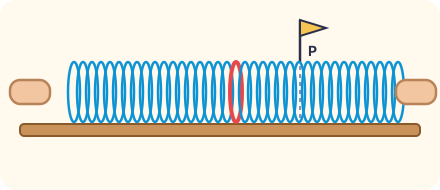
A friend pushes and pulls the end of a slinky steadily. You count 36 compressions passing the flag P in 3 s. What is the frequency of the wave?
Show the answer
B.
Each compression passing P is one oscillation, so 108 Hz comes from multiplying instead of dividing. 0.083 Hz is , the ratio turned upside down (that is actually the time period in seconds), and 36 Hz ignores the 3 s.
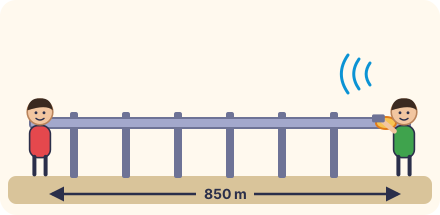
Gunjan presses her ear to a long steel fence. Her friend knocks on the fence 850 m away. Sound travels at in steel and in air, so Gunjan hears two knocks. What is the time gap between them, and can she hear them as separate sounds? (Two sounds must be at least 0.1 s apart to be heard separately.)
- 2.33 s; yes, she hears two separate knocks
- 2.67 s; yes, she hears two separate knocks
- 0.17 s; yes, she hears two separate knocks
- 2.33 s; no, the gap is too short to notice
Show the answer
A. 2.33 s; yes, she hears two separate knocks
Through air: . Through steel: . Gap , far more than 0.1 s, so she hears the knock twice: first through the steel, then through the air. 2.67 s adds the times instead of subtracting, and 0.17 s is only the steel time.
Topics covered
- Tuning fork
- Frequency
- Sound needs a medium
- Production of sound
- Compressions and rarefactions
- Sound in space
- Vibrating parts of instruments
- Particles do not travel with the wave
- Intensity
- Vacuum bell jar
- Wavelength
- Microphones and speakers
- Energy and amplitude
- Amplitude
- SI units
- Speed, frequency and wavelength
- Time period
- Loudness and amplitude
- Pitch and frequency
- Effect of frequency
- Reading a wave graph
- Lightning and thunder
- Speed of sound
- Sound through solids
- Temperature and speed of sound
- Human ear
- How we hear
- Loudness, noise and hearing
- Tone and musical note
- Perception of sound
- Tabla and syaahi
- Musical notes and frequency
- Reflection of sound
- Minimum distance for an echo
- Echo
- Reverberation
- Ultrasonic and infrasonic waves
- Echolocation
- Echo, reverberation and sonar
- Sonar
- Ultrasonic parking sensor
- Speed of sound in air and water
- Longitudinal and transverse waves
- Different ways of making sound