Earth as a System: Energy, Matter, and Life: CBSE Class 9 Physics practice questions
Practise 50 questions on Earth as a System: Energy, Matter, and Life, free, with an explanation for each answer.
Sample questions
UV rays can damage the skin and eyes, but they are also useful. Which of these is a use of UV rays?
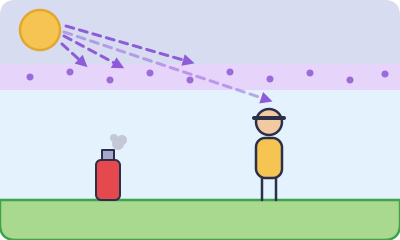
- Providing the energy plants use for photosynthesis
- Carrying radio and television signals
- Killing germs in water purifiers
- Keeping the Earth warm at night
Show the answer
C. Killing germs in water purifiers
UV rays (–, where ) carry more energy than visible light. They are used to kill germs in water purifiers and help power fluorescent lights. Because long exposure harms the eyes and skin and raises cancer risk, people use UV-protective glasses and sunscreen. Photosynthesis uses visible light, signals use radio waves, and night-time warmth is infrared trapped by greenhouse gases.
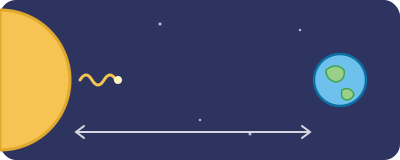
Sunlight crosses about of empty space to reach the Earth. Light travels through a vacuum at . How long does the journey take?
Show the answer
B.
which is about 8.3 minutes. Light can cross a vacuum because it is an electromagnetic wave, while sound (a mechanical wave) cannot. s comes from multiplying instead of dividing, s from dividing the wrong way round, and s from slipping a power of ten.
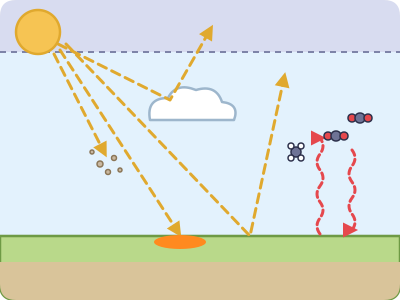
At the top of the atmosphere, the solar constant is about . On a clear day, the highest insolation (sunlight energy received) at the ground is about . Roughly what percentage of the energy is lost on the way down?
- 40%
- 71%
- 29%
- 0.4%
Show the answer
C. 29%
Loss , and This energy is absorbed and scattered by gases, clouds and dust. 40% divides the loss by 1000 instead of by the starting value, 71% is the fraction that does reach the ground, and 0.4% writes the loss as if it were a percentage. The solar constant () is the energy per second per square metre facing the Sun before any absorption.
Topics covered
- Spheres of the Earth
- Interacting spheres
- Electromagnetic spectrum
- Solar radiation
- Electromagnetic waves
- Ultraviolet radiation
- Solar constant and insolation
- Insolation
- Indian scientists
- Solar radiation and the Earth's surface
- Greenhouse effect
- Greenhouse gases
- Albedo
- Re-radiation of heat
- Urban heat island
- Latitude and Earth's shape
- Composition of the atmosphere
- Layers of the atmosphere
- Troposphere
- Role of the atmosphere
- Ozone layer
- Human impact
- Local winds
- Planetary winds
- Ocean currents
- Biogeochemical cycles
- Water cycle
- Climate change and the water cycle
- Carbon cycle
- Keeling curve
- Human impact on oceans
- Nitrogen cycle
- Oxygen cycle
- Eutrophication
- Deforestation