Describing Motion Around Us: CBSE Class 9 Physics practice questions
Practise 50 questions on Describing Motion Around Us, free, with an explanation for each answer.
Sample questions
This puzzle is like one from Ganitakaumudi, a 14th-century Indian maths book. Two messengers start 240 yojanas apart and walk towards each other. One covers 7 yojanas a day and the other covers 5 yojanas a day. After how many days do they meet?
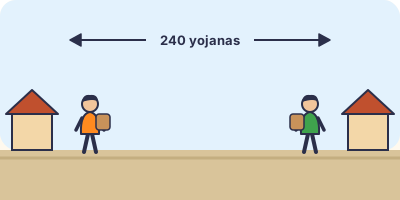
- 120 days
- 48 days
- About 34 days
- 20 days
Show the answer
D. 20 days
Together they close the gap by 7 + 5 = 12 yojanas per day, so they meet after days (by then one has walked 140 yojanas and the other 100). 120 days uses the difference 7 − 5, which would fit only if they walked the same way; 48 and about 34 days use one messenger's speed alone. Speed as distance ÷ time was known in India at least from the Aryabhatiya (5th century CE).
Kabir's family drives 150 km east from town A to town B in 2 h, then drives 150 km west back to A in 3 h. What are the average speed and the average velocity for the whole trip?
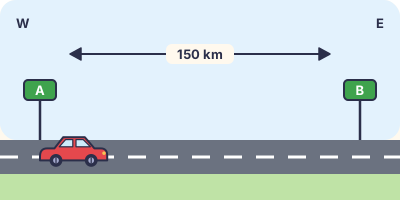
- and
- and
- and towards the east
- and
Show the answer
B. and
Average speed = . The family ends where it started, so the displacement is zero and the average velocity is . 62.5 km/h comes from averaging the two leg speeds (75 and 50 km/h), which is wrong because the legs took different times.
The velocity–time graph is for a scooter on a straight road. What is its displacement from 0 s to 8 s?
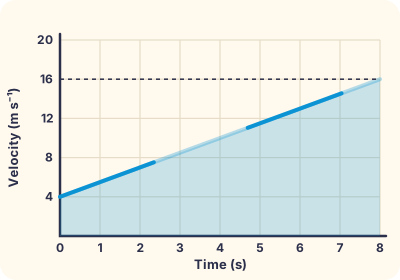
- 128 m
- 48 m
- 32 m
- 80 m
Show the answer
D. 80 m
Displacement = shaded area = rectangle + triangle = . 128 m multiplies the final velocity by the time, as if the scooter had moved at 16 m/s throughout; 48 m and 32 m each leave out one part of the area.
Topics covered
- Describing position
- Distance and displacement
- Position-time graphs
- Slope of a position-time graph
- Velocity-time graphs
- Uniform circular motion
- Velocity in circular motion
- Average speed and average velocity
- India's scientific contributions
- Average acceleration
- Area under a velocity-time graph
- Slope of a velocity-time graph
- Kinematic equations
- Stopping distance and reaction time
- Distance and displacement in circular motion
- Direction of acceleration
- Acceleration from change in direction
- Rest and motion
- Speed in circular motion
- Acceleration in real situations
- Stopping distance and road safety
- Scalars and vectors
- Accelerated motion
- Motion in a plane
- Describing motion: key terms
- Information from motion graphs
- Plotting a graph
- Deriving the kinematic equations
- Acceleration due to gravity