The Rise of Nationalism in Europe: CBSE Class 10 History practice questions
Practise 50 questions on The Rise of Nationalism in Europe, free, with an explanation for each answer.
Sample questions
How is a nation-state different from the multi-national dynastic empires (empires where one royal family ruled over many peoples) of earlier Europe?
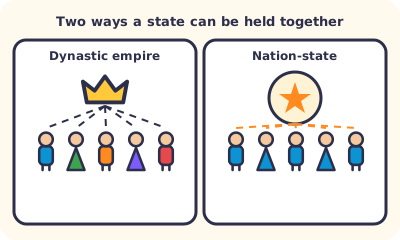
- A centralised power rules a clearly defined territory, which was new in the nineteenth century
- Most citizens, and not only the rulers, share a sense of common identity and history
- It is always ruled by an absolute monarch who speaks the common language
- Its people are bound together only by loyalty to one dynasty
Show the answer
B. Most citizens, and not only the rulers, share a sense of common identity and history
In a nation-state the majority of citizens, not just the rulers, develop a feeling of common identity and shared history; this was forged through struggles. A centralised power controlling a defined territory had been developing for a long time in Europe, so that alone does not define a nation-state. Absolute monarchs and loyalty to a dynasty belong to the dynastic empires.
French revolutionaries took steps to create a collective identity (a shared feeling of being one people). Which of these was not one of those steps?
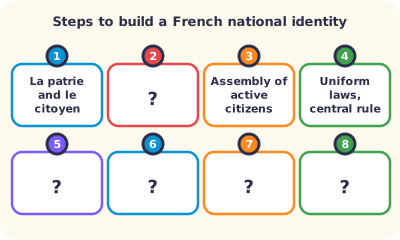
- Abolishing internal customs duties and adopting uniform weights and measures
- Choosing a new tricolour flag in place of the royal standard
- Encouraging each region to keep its own dialect as the national language
- Composing hymns, taking oaths and commemorating martyrs in the name of the nation
Show the answer
C. Encouraging each region to keep its own dialect as the national language
The revolutionaries promoted uniform laws, a centralised administration, the end of internal customs duties, uniform weights and measures, the tricolour, new hymns and oaths, and French as spoken in Paris as the common language. They discouraged regional dialects, so encouraging dialects is the odd one out.
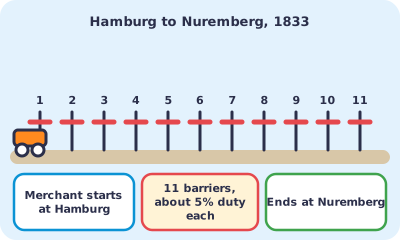
In 1833, a merchant travels from Hamburg to Nuremberg. He passes through 11 customs barriers. At each one, he pays about 5 per cent of the declared value of his goods. Take the declared value to be the same each time. His total duty is about
- 5 per cent
- 16 per cent
- 50 per cent
- 55 per cent
Show the answer
D. 55 per cent
Duty at each barrier is 5% of the same value, so the total is . Taking only one barrier gives 5%; adding 11 + 5 mixes the count and the rate (16); counting 10 gaps between barriers gives %. Such costs made merchants demand a unified economic territory.
Topics covered
- Nation-state
- Sorrieu's vision
- The French Revolution and the nation
- Napoleon's reforms
- Liberalism
- Economic liberalism
- The Zollverein
- Conservatism and censorship
- The July Revolution
- The Greek war of independence
- Timeline
- Romanticism
- Language and nationalism
- Hunger, hardship and revolt
- The revolution of 1848 in France
- The Frankfurt Parliament
- Unification of Germany
- Unification of Italy
- Symbols
- Visualising the nation
- Nationalism and imperialism
- The Habsburg Empire
- The Congress of Vienna
- What is a nation?
- Chronology
- The making of Britain
- The revolutionaries
- Conservatism
- Key terms
- People in the story
- Women and liberty
- Dates