The Making of a Global World: CBSE Class 10 History practice questions
Practise 50 questions on The Making of a Global World, free, with an explanation for each answer.
Sample questions
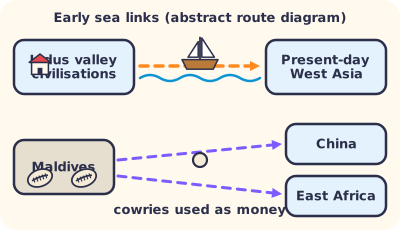
Even as early as 3000 BCE, there was an active coastal trade. This trade linked the Indus valley civilisations with which region?
- The Americas
- Southern Europe
- Present-day West Asia
- Present-day Australia
Show the answer
C. Present-day West Asia
The chapter states that around 3000 BCE coastal trade joined the Indus valley civilisations with present-day West Asia. The Americas were cut off from regular contact with the rest of the world until the sixteenth century, so they cannot be right. Southern Europe and Australia do not appear in the chapter's early trade links.
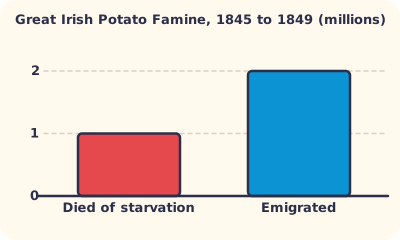
During the Great Irish Potato Famine (1845 to 1849), about 1 million people died of starvation. Double that number emigrated (left to live in other countries). How many people either died or emigrated?
- 1 million
- 3 million
- 2 million
- 4 million
Show the answer
B. 3 million
Deaths million and emigrants million, so together million. 1 million counts only the deaths, 2 million only the emigrants, and 4 million doubles the emigrant figure a second time. Poor peasants depended heavily on potatoes, so the failure of the crop in the mid-1840s was disastrous.
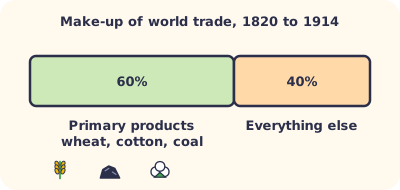
Between 1820 and 1914, world trade multiplied 25 to 40 times. Nearly 60 per cent of this trade was in primary products. Take world trade in 1914 as 2000 units. How many units were primary products?
- 1200 units
- 800 units
- 600 units
- 1940 units
Show the answer
A. 1200 units
units. 800 is the 40 per cent share of other goods; 600 takes 60 per cent of 1000; 1940 subtracts 60 units instead of taking 60 per cent. Primary products are agricultural goods such as wheat and cotton and minerals such as coal.
Topics covered
- The pre-modern world
- Silk routes
- Food travels
- Conquest and disease
- Three flows
- A world economy takes shape
- Role of technology
- Late nineteenth-century colonialism
- Rinderpest
- Indentured labour
- Indian entrepreneurs abroad
- Indian trade and colonialism
- The inter-war economy
- Mass production
- The Great Depression
- India and the Great Depression
- Rebuilding a world economy
- Decolonisation and G-77
- Chronology
- End of Bretton Woods