Print Culture and the Modern World: CBSE Class 10 History practice questions
Practise 50 questions on Print Culture and the Modern World, free, with an explanation for each answer.
Sample questions
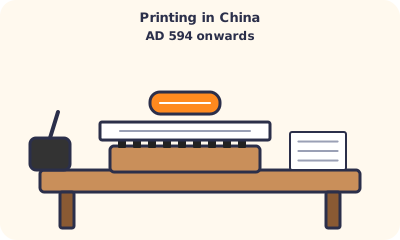
From AD 594 onwards, how were books printed in China?
- By pressing metal letters into damp paper with a screw press
- By rubbing paper against the inked surface of carved woodblocks
- By copying each page by hand onto palm leaves
- By rolling ink over a flat stone with a roller and pressing paper on it
Show the answer
B. By rubbing paper against the inked surface of carved woodblocks
The earliest print technology, developed in China, Japan and Korea, was hand printing: paper was rubbed against the inked surface of woodblocks. Metal-type presses came much later (Gutenberg, 1430s, in Europe), copying on palm leaves is a manuscript tradition, and lithographic presses appear in the Indian story of the nineteenth century.
Woodblock printing was known in China long before it reached Europe. According to the chapter, how did this knowledge reach Italy?
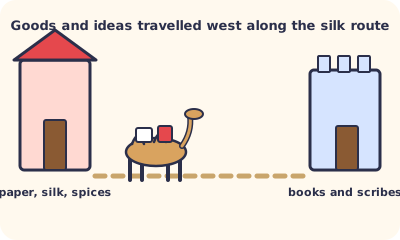
- Marco Polo returned to Italy in 1295 after years in China and brought the knowledge with him
- Chinese paper reached Italy in the eleventh century together with the art of printing
- Johann Gutenberg learnt woodblock printing from Chinese craftsmen at Strasbourg
- Portuguese missionaries carried woodblock printers to Italy
Show the answer
A. Marco Polo returned to Italy in 1295 after years in China and brought the knowledge with him
Silk and spices flowed along the silk route, and Chinese paper reached Europe in the eleventh century. The printing knowledge came when Marco Polo returned to Italy in 1295; Italians then produced books with woodblocks and the technique spread. Paper alone made manuscripts possible but did not carry printing. Gutenberg's breakthrough (1430s) came later, and Portuguese missionaries are part of the Indian story.
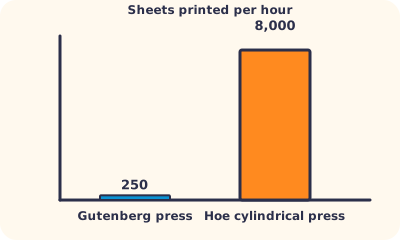
The Gutenberg press could print 250 sheets on one side per hour. By the mid-nineteenth century, Richard M. Hoe's power-driven cylindrical press printed 8,000 sheets per hour. How many times faster was Hoe's press?
- 16 times
- 7,750 times
- 2,000,000 times
- 32 times
Show the answer
D. 32 times
Rate comparison needs division: . Common traps: halving it for two sides gives 16, subtracting gives 7,750 (a difference in sheets per hour, not 'how many times'), and multiplying gives a meaningless 2,000,000. The Hoe press was especially useful for printing newspapers.
Topics covered
- Print in East Asia
- Print in China
- Print in Japan and Korea
- Print in Japan
- Print comes to Europe
- Gutenberg's press
- Print revolution
- Printer's workshop
- A new reading public
- Religious debates
- Print and dissent
- Fear of print
- The reading mania
- Print and the French Revolution
- The nineteenth century
- Workers as readers
- Further innovations
- India before print
- Print comes to India
- Religious reform and public debates
- New forms of publication
- Women and print
- Print and the poor
- Print and censorship
- The twentieth century