Nationalism in India: CBSE Class 10 History practice questions
Practise 50 questions on Nationalism in India, free, with an explanation for each answer.
Sample questions
In colonies like India, the growth of modern nationalism is closely tied to the anti-colonial movement (the struggle against colonial rule). Why?

- Colonial rulers deliberately taught Indians to feel like one nation
- People discovered their unity while struggling together against colonial rule
- Every class and group understood freedom in exactly the same way
- Nationalism started only after the colonial rulers had left
Show the answer
B. People discovered their unity while struggling together against colonial rule
In colonies, the sense of being oppressed under colonialism gave many different groups a shared bond, so people found their unity in the struggle itself. The unity was not automatic: each class felt colonialism differently and their ideas of freedom were not always the same, which is why the Congress had to work to hold the groups together.
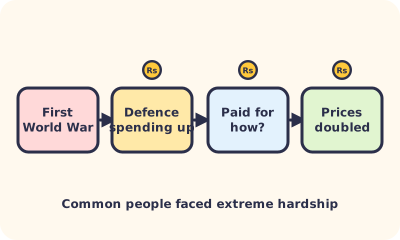
During the First World War, defence expenditure (spending on the army and war) increased hugely. How did the colonial government pay for it?
- Through war loans and higher taxes, with customs duties raised and income tax introduced
- By cutting customs duties and abolishing income tax to please traders
- Through gifts of money from the Ottoman emperor
- By fixing prices so that nothing became costlier
Show the answer
A. Through war loans and higher taxes, with customs duties raised and income tax introduced
The war raised defence spending sharply. It was financed by war loans and increasing taxes: customs duties were raised and income tax was introduced. Prices then doubled between 1913 and 1918, so ordinary people suffered. Lower taxes, foreign gifts or price control are the opposite of what happened.
Rich peasants like the Patidars and Jats supported the Civil Disobedience Movement with great enthusiasm. Why?

- They wanted unpaid rent to landlords to be remitted
- As producers of commercial crops hit by falling prices, they could not pay the revenue and saw swaraj as a fight against high revenue
- They wanted protection from imports and a favourable rupee-sterling ratio
- They wanted separate electorates for their community
Show the answer
B. As producers of commercial crops hit by falling prices, they could not pay the revenue and saw swaraj as a fight against high revenue
Rich peasants grew commercial crops; the trade depression destroyed their cash incomes while the government refused to reduce revenue. For them swaraj meant a struggle against high revenues. Remission of rent was the demand of small tenants, protection from imports that of business classes. They were disappointed when the movement ended in 1931 with no revenue revision, so many stayed out in 1932.
Topics covered
- Nationalism and colonialism
- The First World War
- Satyagraha
- Early satyagrahas
- The Rowlatt Act
- The Rowlatt satyagraha
- Jallianwalla Bagh
- Khilafat
- Why non-cooperation?
- Non-Cooperation movement
- Movement in the towns
- Rebellion in the countryside
- Swaraj in the plantations
- Towards civil disobedience
- Salt march
- Civil disobedience
- How participants saw the movement
- The limits of civil disobedience
- Sense of collective belonging
- Key terms
- Other strands
- Quit India Movement