Shaping of the Earth’s Surface: CBSE Class 9 Geography practice questions
Practise 50 questions on Shaping of the Earth’s Surface, free, with an explanation for each answer.
Sample questions
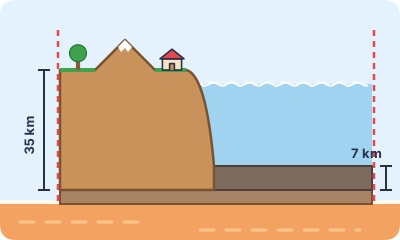
This slab of the Earth's outer layer carries both a continent and part of an ocean floor. What kind of tectonic plate is it?
- Oceanic plate
- Mixed plate
- Continental plate
- Transform plate
Show the answer
B. Mixed plate
Continental plates carry continents, oceanic plates carry ocean floors and mixed plates carry both. The chapter names seven major plates: Pacific, Eurasian, African, North American, South American, Indo-Australian and Antarctic. There is no 'transform plate'; transform is a type of plate boundary.
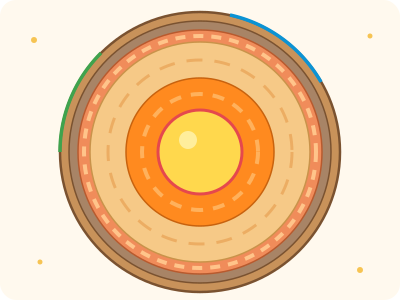
The Earth's radius is about . The inner core's radius is about . Roughly how deep below the surface does the inner core begin?
Show the answer
C.
Depth to the top of the inner core = radius of Earth − radius of inner core: km comes from adding instead of subtracting, km is just the inner core's radius (measured from the centre), and km comes from subtracting the mantle's thickness (2,900 km) by mistake.
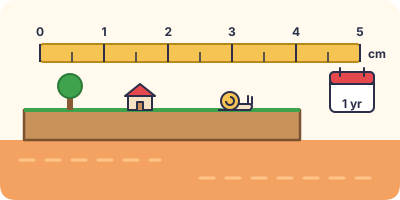
A plate moves slowly at per year. How long will it take to move 1 km?
- 250 years
- 4,00,000 years
- 2,500 years
- 25,000 years
Show the answer
D. 25,000 years
. 250 years comes from taking 1 km as only 1000 cm, 2,500 years from taking it as 10,000 cm, and 4,00,000 years from multiplying instead of dividing.
Topics covered
- Interior of the Earth
- Tectonic plates
- Plate tectonics
- Convection currents
- Plate boundaries
- Earthquakes and volcanoes
- Plate movement rate
- Heat inside the Earth
- Earthquakes in early India
- Volcanoes
- Earthquake safety
- Internal and external forces
- Weathering
- Weathering and erosion
- Erosion and livelihoods
- Soil and water conservation
- Agents of gradation
- Landforms and history
- Running water
- Waterfall
- Meander
- Delta
- Coastal landforms
- Beaches
- Glacial landforms
- Wind landforms
- Sand dunes
- Underground water
- Landslides
- Avalanches
- GLOFs
- Dust storms