Oceans and Life: CBSE Class 9 Geography practice questions
Practise 50 questions on Oceans and Life, free, with an explanation for each answer.
Sample questions
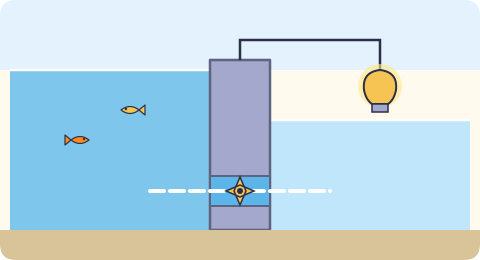
The rise and fall of tides can turn turbines like the one shown. Which group lists places in India that are named as major tidal energy sites?
- The Mariana Trench, the Mid-Ocean Ridge and Mauna Kea
- The Thar Desert, the Deccan Plateau and the Chota Nagpur Plateau
- The Gulf of Mexico, the Labrador coast and Norway
- The Gulf of Kutch, the Gulf of Khambhat and the Sundarbans
Show the answer
D. The Gulf of Kutch, the Gulf of Khambhat and the Sundarbans
The Gulf of Kutch, the Gulf of Khambhat and the Sundarbans are among India's major tidal energy sites. The Gulf of Khambhat has a tidal range of about 12 m. India has a coastline of 11,098.81 km, but tidal energy is not yet used on a large scale. Inland deserts and plateaus have no tides, and the other options are ocean-floor features or places outside India.
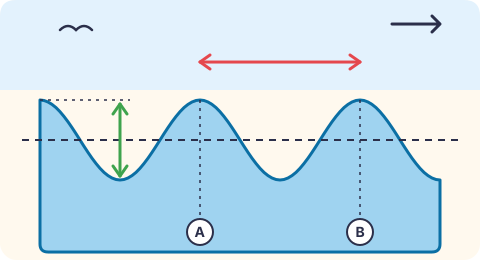
A buoy floats at point A. In one minute, 12 wave crests pass it. What is the wave frequency?
- 12 crests per second
- 5 crests per second
- 0.2 crests per second
- 720 crests per second
Show the answer
C. 0.2 crests per second
Wave frequency = number of crests passing point A each second: Saying 12 forgets to change minutes into seconds, and 720 multiplies by 60 instead of dividing. 5 comes from ; that is actually the wave period (5 s), the time a crest takes to travel from A to B.
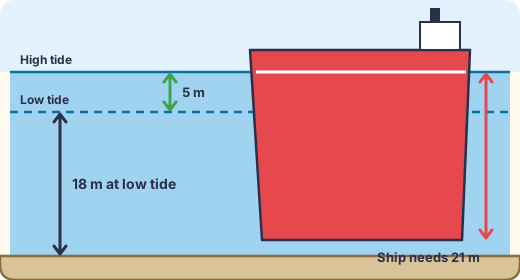
A giant oil tanker needs at least of water to pass safely. The channel is deep at low tide. The tidal range is . How deep is the channel at high tide, and when can the tanker pass?
- ; only around high tide
- ; it can never pass
- ; at any time of day
- ; at any time of day
Show the answer
A. ; only around high tide
Depth at high tide = low-tide depth + tidal range , which is more than the needed. At low tide only is left, so the ship would run aground. It must wait for high tide, just as very large crude carriers do in the shallow Singapore Strait. comes from subtracting the range, and 'any time' ignores the low tide. This is why ships check both the water depth and the tidal range before berthing.
Topics covered
- Ocean relief
- Waves
- Tides
- Ocean currents
- Cyclones and tsunamis
- Marine resources
- Maritime zones
- Maritime rules