The Price Puzzle: What Drives the Market: CBSE Class 9 Economics practice questions
Practise 50 questions on The Price Puzzle: What Drives the Market, free, with an explanation for each answer.
Sample questions
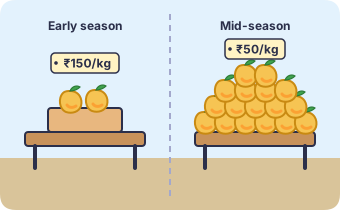
Mangoes are costly at the start of the season and much cheaper a few weeks later. The prices of snacks, movie tickets, phones, vegetables and all other goods and services are decided by two powerful forces. What are they?
- Advertising and packaging
- Demand and supply
- Shop rent and electricity bills
- Rumours and festivals
Show the answer
B. Demand and supply
The chapter says prices do not change randomly: they are set by demand (what buyers want and can pay for) and supply (what sellers offer). Seasons, festivals, trends and even rumours matter only because they change demand or supply. Early in the season few mangoes reach the market, so they are dear; when the harvest arrives in bulk, the price falls.
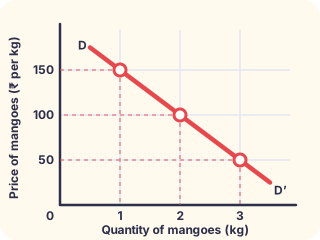
Using Srivalli's demand schedule (₹150 → 1 kg, ₹100 → 2 kg, ₹50 → 3 kg), at which price does she spend the most money on mangoes?
- ₹100 per kg, spending ₹200
- ₹50 per kg, because she buys the most
- ₹150 per kg, because the price is highest
- She spends the same amount at every price
Show the answer
A. ₹100 per kg, spending ₹200
Total spending = price × quantity: ₹150 × 1 = ₹150, ₹100 × 2 = ₹200, and ₹50 × 3 = ₹150. So she spends the most at ₹100 per kg. Buying the largest quantity (3 kg) or paying the highest price (₹150) does not by itself give the biggest bill, because the other factor is small. The three amounts are not equal, so the last option is wrong too.
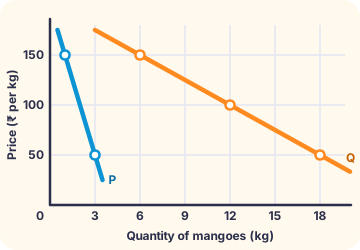
In the chapter's mango example, the price falls from ₹150 to ₹50 per kg. Srivalli then buys 2 kg more. But market demand (Srivalli, Alex and Israt together) goes up by 12 kg. Why is the market demand curve flatter than Srivalli's demand curve?
- Market demand adds up many buyers, so the same fall in price produces a much larger change in total quantity
- Sellers charge lower prices in the market than they charge Srivalli on her own
- The Law of Demand applies to the whole market but not to individual buyers
- Market demand is the average of all buyers' demands, which smooths out the curve
Show the answer
A. Market demand adds up many buyers, so the same fall in price produces a much larger change in total quantity
Market demand aggregates many consumers. For the same ₹100 fall in price, Srivalli's quantity rises by 2 kg (1 → 3 kg) but the market's rises by 12 kg (6 → 18 kg), so the market curve is flatter and more responsive. Everyone faces the same price, the Law of Demand applies to every buyer, and market demand is a sum, not an average.
Topics covered
- The Big Questions: what moves prices
- Meaning of demand
- Law of Demand
- Reading a demand curve
- Total spending = price × quantity
- Demand schedule and demand curve
- Market demand
- Why the market demand curve is flatter
- Individual and market demand curves
- Let's Explore: your own demand schedule
- Substitute goods
- Complementary goods
- Substitutes and complements
- Related goods: dearer petrol
- Other determinants of demand
- Population size and composition
- Diminishing marginal utility
- Seasonality
- Law of supply and the supply curve
- Market supply
- Supply through the mango season
- Other determinants of supply
- Technology and supply: drip irrigation
- Effect of better technology on the market
- Market equilibrium from a schedule
- Shortage (excess demand)
- Surplus (excess supply)
- Market equilibrium on a graph
- Surplus and shortage on a graph
- How a shortage moves the market to equilibrium
- Does equilibrium exist in the real world?
- Face masks during the pandemic
- A shift in demand
- Percentage change in price
- Dynamic hotel tariffs
- Hotel tariffs change with demand
- What hotels watch when setting tariffs
- Sustainability and future supply
- Price floor
- Price ceiling below the market price
- Price distortions
- Sanitisers during COVID-19
- Key terms: government and markets
- Market regulators
- Public goods
- Why public goods need the government
- Why the government steps into markets
- Limitations of government intervention
- Democracy and market intervention
- Why prices change during the day