From Ideas to Startups: CBSE Class 9 Economics practice questions
Practise 50 questions on From Ideas to Startups, free, with an explanation for each answer.
Sample questions
At your school festival, you join the 'Young Entrepreneurs Challenge'. You run a nimbu pani stall with your classmates. You decide how much to spend on lemons and sugar, where to get glasses and how much to charge for each glass. At the end, you report your expenses and profit. The chapter says this shows the main idea of entrepreneurship. What is entrepreneurship?

- Working for a fixed salary in someone else's business
- Collecting donations to pay for a school event
- The process through which an individual, or a group, turns a potential idea into a business venture
- Buying goods only for your own family's use
Show the answer
C. The process through which an individual, or a group, turns a potential idea into a business venture
Entrepreneurship is the process by which a person or a group converts a potential idea into a business venture. The stall captures its essence: planning, organising and learning by doing, and then checking whether you made a profit or a loss. The chapter's figure of its elements includes opportunities, innovation, market, team, goal, strategy and analysis. A salaried job, donations or buying for yourself do not turn an idea into a venture.
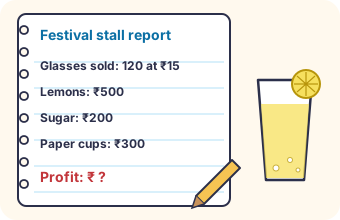
Your stall's notebook says: 120 glasses sold at ₹15 each. Costs: lemons ₹500, sugar ₹200, paper cups ₹300. What profit should you report to your teacher?
- ₹1,800
- ₹1,100
- ₹2,800
- ₹800
Show the answer
D. ₹800
Revenue . Total expenses . Profit = Total revenue − Total expenses . ₹1,800 is the revenue, not the profit; ₹1,100 forgets the cost of cups; ₹2,800 adds the costs instead of subtracting them.
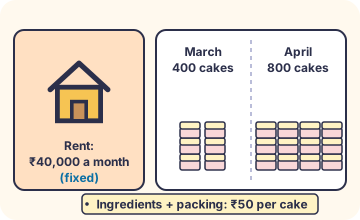
A bakery pays rent of ₹40,000 a month (fixed). Ingredients and packaging cost ₹50 per cake (variable). In March it bakes 400 cakes. In April it bakes 800 cakes. What is the bakery's total cost for April?
- ₹1,20,000
- ₹60,000
- ₹80,000
- ₹40,000
Show the answer
C. ₹80,000
Total cost = fixed cost + variable cost per cake × number of cakes . ₹1,20,000 doubles March's total of ₹60,000, wrongly doubling the rent too. ₹60,000 is March's cost, and ₹40,000 counts only the rent. Doubling output doubles only the variable part.
Topics covered
- What is entrepreneurship? The Young Entrepreneurs Challenge
- Fixed and variable costs at the stall
- Calculating the stall's profit
- Key terms
- Tasks performed by an entrepreneur
- Jataka tale: From a Dead Mouse to Riches
- Jataka tale: steps to a fortune
- Lijjat: From Rooftop to Revolution
- Lijjat as a cooperative
- Lijjat's growth over time
- Sharing profits equally in a cooperative
- Lijjat's turnover growth
- Mohan Singh Oberoi: taking a risk
- Functional areas in Oberoi's hotels
- From idea to venture: the stall
- What is a business plan?
- Business plan: challenges and risks
- Business plan: pricing and profits
- Steps of a business plan
- Variable costs of a bakery
- Fixed costs
- Total cost when output changes
- Functional areas: marketing and sales
- Functional areas: finance and accounting
- Functional areas: management and operations
- Key focus of each functional area
- Human resources in a bakery
- Marketing strategies for a bakery
- Profit and loss account: total income
- Profit and loss account: spotting a fixed cost
- Profit before and after tax
- Effect of a rise in rent on profit
- Cost per unit
- Selling enough to cover costs (break-even)
- Profit as a percentage of revenue
- Arranging funds for a business
- Why a business with a great idea can fail
- A business plan is a dynamic road map
- India's traditional entrepreneurial community: the Chettiars
- Startups and unicorns
- Fields where startups work
- Failure as a lesson
- Perseverance
- Startup India and Atmanirbhar Bharat
- Contribution of businesses to society
- The Dandekar brothers: spotting an opportunity
- The Dandekar brothers' journey
- Turning a daily problem into a business idea
- Barriers to growth seen on a factory visit
- Process map: from raw materials to the customer