Managing Your Personal Finances: CBSE Class 9 Economics practice questions
Practise 50 questions on Managing Your Personal Finances, free, with an explanation for each answer.
Sample questions
Our journey with money starts in childhood — pocket money, festival gifts, saving coins in a gullak. What does personal finance mean?

- Only the money the government collects as taxes
- Planning and managing a person's money to meet needs and wants
- Keeping all your money in a piggy bank so that it is never spent
- The accounts that a large company keeps of its profits
Show the answer
B. Planning and managing a person's money to meet needs and wants
Personal finance is the planning and management of an individual's money to meet their needs and wants. It involves smart decisions about how much to spend, how much to save, where to invest and how to prepare for future needs, such as buying a house in five years. Hiding all money away (c) is not management, and taxes or company accounts are not personal finance.
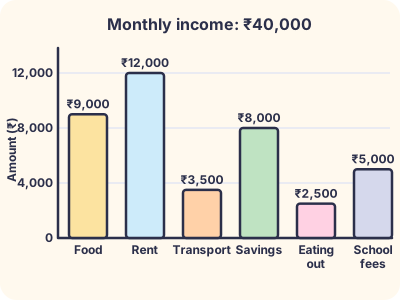
In the same budget, the family earns ₹40,000 a month and saves ₹8,000. What percentage of its income does the family save?
- 20%
- 25%
- 80%
- 8%
Show the answer
A. 20%
Savings rate . 25% comes from dividing by spending (₹32,000) instead of income, 80% is the share that is spent, and 8% just copies the ₹8,000 figure. The chapter's activity asks the same question: what percentage of the money did you save?
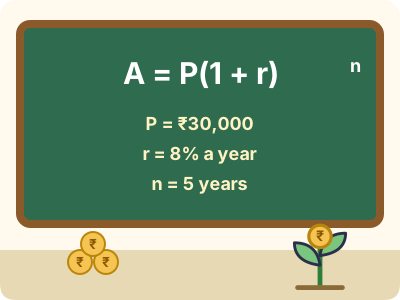
In the chapter's activity, a family saves ₹30,000 at 8% compound interest a year. Using , find about how much interest it earns in 5 years. (Take .)
- ₹12,000
- ₹14,080
- ₹44,080
- ₹2,400
Show the answer
B. ₹14,080
, so interest . ₹12,000 is simple interest (), which ignores interest on interest; ₹44,080 is the amount, not the interest; ₹2,400 is only one year's interest.
Topics covered
- The Big Questions: what is personal finance
- Pillars of personal finance
- Income: sources of earnings
- Think About It: Earn While You Learn
- Budgeting: planning expenses
- Steps in budgeting
- Setting a savings goal
- Reading a family budget
- Budgeting controls unnecessary spending
- Savings rate
- Activity: School Reopening Budget
- Budgeting: living within your means
- Saving: why people save
- Save first, spend later
- Saving versus investing
- Investing: the mango tree
- Inflation and prices
- Key money terms
- Inflation and purchasing power
- Power of early investment: the graph
- Power of early investment
- How compounding works
- Compound interest for two years
- Activity: save for the future with compound interest
- Fixed deposits and government-backed schemes
- Bonds: interest and maturity
- Bonds: government and corporate
- Stocks (equity or shares)
- Let's Analyse: the BSE SENSEX
- Mutual funds and market risk
- Common investment options
- Risk and return trade-off
- Ranking investments by risk
- Factors to consider before investing
- Insurance: premium and risk sharing
- Types of insurance
- Why people buy insurance
- Borrowing and credit
- Think About It: EMIs
- Reading a passbook
- Taxes: direct and indirect
- Calculating income tax with slabs
- Taxable income and standard deduction
- Tax slabs: Priya's example
- Steps to calculate income tax
- Progressive taxation
- Who runs the income tax system
- Activity: needs and wants in a family budget