Building Blocks in Economics: The Problem of Choice: CBSE Class 9 Economics practice questions
Practise 50 questions on Building Blocks in Economics: The Problem of Choice, free, with an explanation for each answer.
Sample questions
Buy snacks now or save for new shoes? Share five library copies among twenty readers? Which crop to sow? Use more workers or more machines? Build highways or hospitals? What do all these questions have in common?
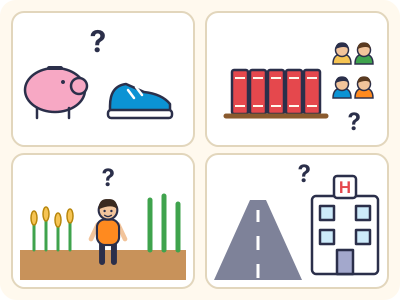
- They are questions about the past that only History can answer
- They are economic choices that individuals, enterprises and governments have to make
- They concern only the government, never households or students
- They can all be settled without giving anything up
Show the answer
B. They are economic choices that individuals, enterprises and governments have to make
The chapter says these are not random questions but economic choices: a student (pocket money), a school (books), a farmer (crops), an enterprise (labour or capital) and a government (highways or hospitals) all have to decide how to use limited resources. Every such choice means giving something up, so option (d) is wrong, and households make these choices as much as governments do.
Meena has ₹300. A pair of sports shoes costs ₹250 and a packet of snacks costs ₹25. If she buys the shoes, what is their opportunity cost in packets of snacks?
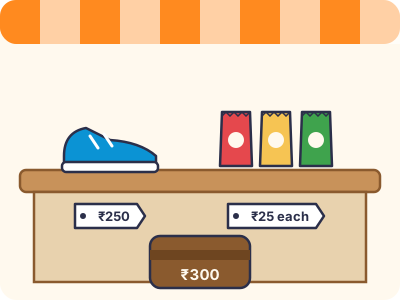
- 12 packets
- 2 packets
- 10 packets
- 0.1 packet
Show the answer
C. 10 packets
The ₹250 spent on the shoes could have bought packets, so the opportunity cost is 10 packets. 12 packets divides her whole ₹300, but she still has ₹50 after buying the shoes. 2 packets is what that leftover ₹50 can still buy, and 0.1 turns the ratio upside down.
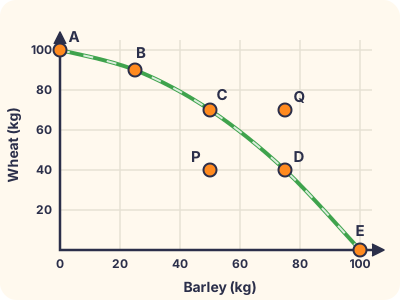
On the farmer's PPC, she moves from D (75 kg barley, 40 kg wheat) to E (100 kg barley, 0 kg wheat). What is the opportunity cost of each extra kilogram of barley in this move?
- 0.625 kg of wheat
- 1 kg of wheat
- 1.6 kg of wheat
- 40 kg of wheat
Show the answer
C. 1.6 kg of wheat
She gives up kg wheat to gain kg barley, so each kg of barley costs kg of wheat. 0.625 divides the wrong way, 1 kg is the average over the whole curve (100 kg wheat for 100 kg barley), and 40 kg is the cost of all 25 kg, not of one kilogram. Notice the cost here is higher than in earlier moves.
Topics covered
- The Big Questions: everyday choices
- Needs and wants
- Human wants keep changing
- Key questions in economics
- Choices and limited resources
- Natural and human-made resources
- Factors of production
- How to produce: labour or capital
- Opportunity cost
- Opportunity cost: shopping
- Time as a scarce resource
- Sharing a scarce resource
- Opportunity cost from a choice table
- Production possibility curve
- Opportunity cost along the PPC
- Moving along the PPC
- Working out opportunity cost
- Production possibilities for a government
- Government budget choices
- Meaning of economics
- Economic Survey
- Economic Survey and the Union Budget
- Scope of work of economists
- Essential and non-essential spending
- Planning a family budget
- Key terms
- How to produce
- What to produce: crops and sustainability
- For whom to produce
- Labour-intensive and capital-intensive production
- How to produce: choosing a technique
- How to produce: comparing costs
- Planned economy
- Market economy
- Economic systems
- Examples of economic systems
- Public goods
- Mixed economy
- Don't Miss Out: India's economic system
- Don't Miss Out: the 1991 reforms