Tissues in Action: CBSE Class 9 Biology practice questions
Practise 50 questions on Tissues in Action, free, with an explanation for each answer.
Sample questions
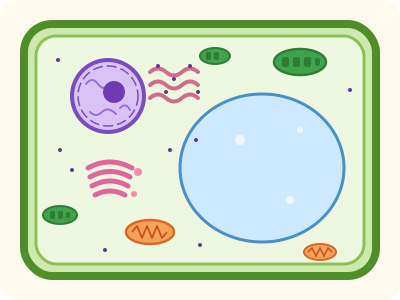
Plants stay fixed in one place, but a tall tree stands upright for years. Which feature of plant cells helps plant tissues the most in giving this support?
- Cells that can change shape easily
- A rigid cell wall around each cell
- Many mitochondria in every cell
- Cells that have no nucleus
Show the answer
B. A rigid cell wall around each cell
Plants cannot move, so their tissues must keep them firm and upright. Plant cells have a cell wall that gives rigidity and strength. Animal cells lack a cell wall and can change shape easily, which suits movement from place to place.
A disc of wood is cut from a young tree, and its bark is removed. The disc is 24 cm across and has 6 annual rings. On average, by how much did the trunk's radius grow each year?

- 4 cm per year
- 0.25 cm per year
- 1 cm per year
- 2 cm per year
Show the answer
D. 2 cm per year
Radius = 24 ÷ 2 = 12 cm, laid down over 6 years (one ring per year), so 12 ÷ 6 = 2 cm per year. Dividing the diameter by 6 (4 cm) forgets to halve it, 6 ÷ 24 turns the ratio upside down, and counting each light and dark band as a separate year doubles the count to 12, giving 1 cm. The rings are made by the lateral meristem.
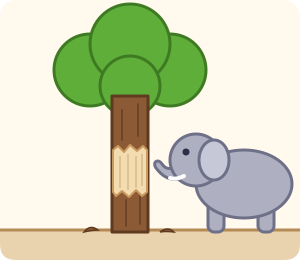
An elephant peeled a band of bark off this tree to eat it. Months later, the roots begin to starve, even though the leaves are still green and making food. Damage to which tissue best explains this? (This tissue lies just under the bark.)
- Xylem
- Phloem
- Sclerenchyma
- Shoot apical meristem
Show the answer
B. Phloem
Phloem lies just inside the bark, so a stripped band tears it away. Phloem carries food from the leaves down to the roots; with the band broken, food cannot pass and the roots slowly starve. Xylem lies deeper in the wood and carries water upward, which is why the leaves stay green for a while.
Topics covered
- Complex permanent tissues
- Lateral meristem
- Apical meristem
- Intercalary meristem
- Protective tissue: epidermis
- Nervous tissue
- Connective tissue: ligament
- Types of joints
- Skeletal system
- Plant and animal tissues
- Annual rings
- Musculoskeletal system
- Connective tissue: blood
- Muscular tissue
- Simple permanent tissues
- Crown gall disease
- Plant tissue culture
- Totipotency
- Cork cambium
- Yoga and health
- Tissue systems
- Meristematic tissue
- Connective tissue
- Permanent tissues
- Epithelial tissue
- Differentiation
- Connective tissue: tendon