Patterns in Life: Diversity and Classification: CBSE Class 9 Biology practice questions
Practise 50 questions on Patterns in Life: Diversity and Classification, free, with an explanation for each answer.
Sample questions
Meena and Hari spot a small animal in the garden. Hari says it is an insect. Meena says it is an earthworm. Which feature would show that it is an insect?
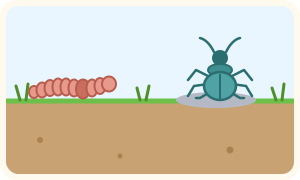
- Its body is bilaterally symmetrical
- Its body is cylindrical
- It has jointed legs
- Its body is divided into segments
Show the answer
C. It has jointed legs
Jointed legs and a hard exoskeleton are the defining features of arthropods such as insects. An earthworm (Annelida) is also segmented and bilaterally symmetrical, and its body is cylindrical, so those features cannot tell the two apart.
Sponges do not have true tissues and organs. Which feature of sponge cells supports placing them in the animal kingdom?

- They have a cell membrane but no cell wall
- They contain chloroplasts
- They have a cellulose cell wall
- They lack mitochondria
Show the answer
A. They have a cell membrane but no cell wall
Animal cells are bounded only by a cell membrane, with no cell wall, and sponge cells are the same. Chloroplasts and cellulose walls are plant features, so B and C point away from animals. Sponge cells, like other animal cells, do have mitochondria.
You find an unlabelled slide of a single-celled organism with a well-defined nucleus and many cilia. Which kingdom does it most likely belong to?

- Monera
- Fungi
- Plantae
- Protista
Show the answer
D. Protista
A true nucleus rules out Monera, whose members are prokaryotes. Being single-celled and moving with cilia fits Protista, the kingdom of unicellular eukaryotes such as Paramecium. Plants are multicellular, and single-celled fungi such as yeast have a chitin wall and do not swim with cilia.
Topics covered
- Ecological roles
- Bryophyta
- Vertebrates
- Kingdom Protista
- Pteridophyta
- Hierarchy of classification
- Five kingdom classification
- Fossils as evidence
- Invertebrate phyla
- History of classification
- Classes of Plantae
- Adaptations
- Hay infusion
- Levels of organisation in animals
- Gymnosperms
- Porifera
- Viruses and classification
- Need for classification
- Endemic species
- Biodiversity hotspots
- Kingdom Fungi
- Binomial nomenclature
- Case study: classifying unknown organisms
- Arthropoda
- Kingdom Monera
- Indian contributions
- Lichens
- Protochordates
- Echinodermata
- Naming new species
- Biodiversity and disasters
- Biodiversity under threat
- Three domain system