Power-sharing: CBSE Class 10 Politics practice questions
Practise 50 questions on Power-sharing, free, with an explanation for each answer.
Sample questions
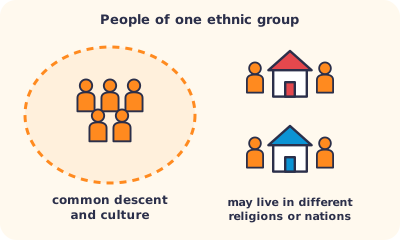
Which statement best describes an ethnic group, as used in the chapter?
- People who always follow the same religion
- People who are citizens of the same nation
- People who live in the same region and speak any language
- People who believe in a common descent because of similarities of physical type, culture or both
Show the answer
D. People who believe in a common descent because of similarities of physical type, culture or both
An ethnic group is a social division based on shared culture; its members believe in a common descent. They need not share the same religion or nationality, so religion-only and nation-only definitions are wrong.
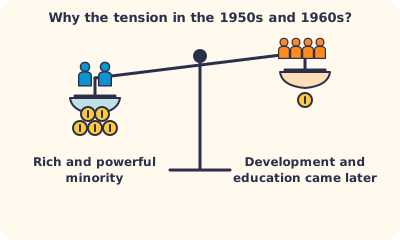
What was the main cause of tension between the Dutch-speaking and French-speaking communities of Belgium in the 1950s and 1960s?
- The French-speaking people resented the earlier wealth of the Dutch-speaking majority.
- The government had declared Dutch the only official language of Belgium.
- The Dutch-speaking people resented the relative wealth and power of the minority French-speaking community.
- The German-speaking community demanded control of the whole country.
Show the answer
C. The Dutch-speaking people resented the relative wealth and power of the minority French-speaking community.
The French-speaking minority was relatively rich and powerful, while the Dutch-speaking community got the benefits of development and education much later. This resentment caused tension, especially in Brussels. The language-Act story belongs to Sri Lanka, not Belgium.
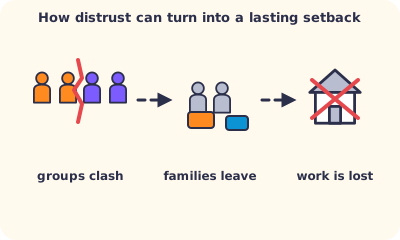
As described in the chapter, which of these was a result of the civil war in Sri Lanka?
- Sri Lanka became a federation in which the Tamil provinces had equal powers.
- Tamil was recognised as an official language, ending the conflict in 1980.
- The war ended quickly because the majority community shared power.
- Thousands of people of both communities were killed and many families left the country as refugees.
Show the answer
D. Thousands of people of both communities were killed and many families left the country as refugees.
The civil war killed thousands from both communities, forced many families to leave as refugees and ruined many livelihoods. It ended in 2009. The other options describe power-sharing outcomes that did not happen in Sri Lanka.
Topics covered
- Belgium: a complex society
- Key terms
- Sri Lanka: a diverse society
- Majoritarianism in Sri Lanka
- Accommodation in Belgium
- Lessons from the two stories
- Why power sharing is desirable
- Lebanon: Khalil's dilemma
- Forms of power sharing