Federalism: CBSE Class 10 Politics practice questions
Practise 50 questions on Federalism, free, with an explanation for each answer.
Sample questions
Look at the two systems drawn here. Which statement correctly defines federalism?
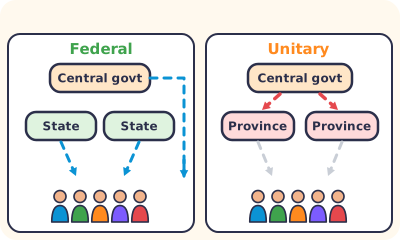
- A system with only one level of government, or one in which the sub-units are subordinate to the central government
- A system in which power is divided among the legislature, the executive and the judiciary
- A system in which the national government hands some powers to the provinces but can take them back whenever it likes
- A system of government in which power is divided between a central authority and various constituent units of the country, each enjoying its power independent of the other
Show the answer
D. A system of government in which power is divided between a central authority and various constituent units of the country, each enjoying its power independent of the other
In a federation power is divided between the country-level government and the governments of the provinces or states, and both enjoy their power independently. Option A describes a unitary system. Option B is the horizontal separation of powers among organs of government, not a division between levels. Option C describes how Belgium's regional governments were placed before 1993, when their powers could be withdrawn by the Central Government.
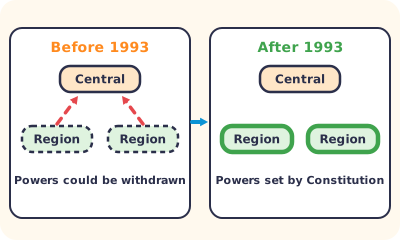
Until 1993, Belgium had regional governments, but the Central Government could take away their powers. What change in 1993 made Belgium a federal country?
- The Central Government was abolished and only regional governments remained
- The regional governments were given constitutional powers that no longer depended on the Central Government
- Regional governments were created for the first time in Belgium
- The regional governments received more powers, but the Central Government could still take them back
Show the answer
B. The regional governments were given constitutional powers that no longer depended on the Central Government
Regional governments already existed in Belgium. What changed in 1993 was that their powers were put on a constitutional footing, independent of the Central Government, so Belgium shifted from a unitary to a federal form. Abolishing the centre (A) was not done, new creation (C) is wrong because they existed earlier, and powers that can still be withdrawn (D) would remain a unitary arrangement. Sri Lanka, by contrast, is for practical purposes still unitary.
Which statement about the two routes to federation is correct?
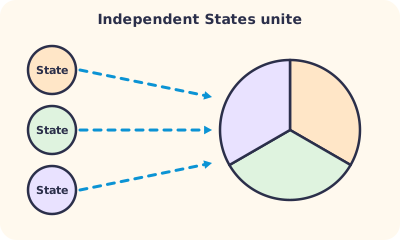
- In 'coming together' federations such as the USA, Switzerland and Australia, the States usually have equal power and are strong compared with the federal government
- In 'holding together' federations such as India, Spain and Belgium, all States have equal powers and the Centre is weak
- In 'coming together' federations a large country divides its power among States
- In 'holding together' federations independent States merge to pool their sovereignty for security
Show the answer
A. In 'coming together' federations such as the USA, Switzerland and Australia, the States usually have equal power and are strong compared with the federal government
Coming together: independent States join, pooling sovereignty to increase security, usually with equal and strong States. Holding together: a large country divides power; the Central Government tends to be more powerful and units may have unequal powers. Options B, C and D each swap the features of the two routes.
Topics covered
- What is federalism?
- Belgium and Sri Lanka
- Federal and unitary systems
- Holding together
- Federal countries of the world
- Features of federalism
- Role of courts
- Coming together and holding together
- Union of States
- Union List
- Concurrent List
- Residuary powers and defence
- Special status
- Linguistic diversity
- Hindi and other languages
- Reading the language table
- Language policy
- Centre-State relations
- Why decentralisation?
- Local government reforms
- Gram Sabha
- Levels of government
- Third tier
- State List
- Gram panchayat
- Rural local bodies
- Urban local bodies
- Participative budgeting
- Key features
- Linguistic States
- 1992 amendment
- Union Territories
- Local government today
- Changing power sharing
- Rural local government
- The English language issue
- Chronology
- Making of the Union
- Is India federal?
- Residuary subjects
- Coming together federations
- Hindi in India
- Sharing with local bodies
- Offices of government
- The three lists
- Types of federation
- Local government terms
- Key terms