The Human Eye and the Colourful World: CBSE Class 10 Physics practice questions
Practise 50 questions on The Human Eye and the Colourful World, free, with an explanation for each answer.
Sample questions
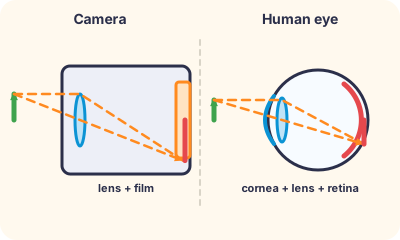
The eye lens focuses light from a distant tree on the retina. What is the nature of this image?
- Virtual and erect
- Real and inverted
- Real and erect
- Virtual and inverted
Show the answer
B. Real and inverted
The human eye is like a camera. Its lens system forms a real, inverted image on the light-sensitive screen called the retina. A virtual image cannot be caught on a screen, and an erect image would need an extra reversal that the eye lens does not produce. The upright view is restored later by the brain.
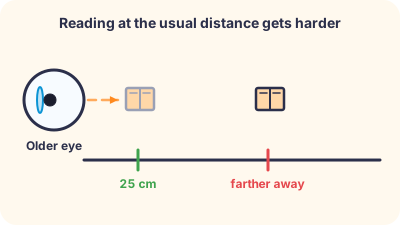
A man in his sixties sees distant objects clearly. But slowly, he finds it hard to read a newspaper at the usual distance. What is this defect, and what causes it?
- Presbyopia: weakening of the ciliary muscles and diminishing flexibility of the eye lens
- Myopia: excessive curvature of the eye lens
- Cataract: the crystalline lens becomes milky and cloudy
- Hypermetropia: the eyeball suddenly becomes too small
Show the answer
A. Presbyopia: weakening of the ciliary muscles and diminishing flexibility of the eye lens
The power of accommodation usually decreases with ageing. The ciliary muscles weaken and the lens becomes less flexible, so the near point gradually recedes. This is presbyopia. Myopia is a distant-vision defect, cataract makes the lens cloudy (the vision is dimmed, not just out of focus for reading), and an eyeball does not suddenly shrink.
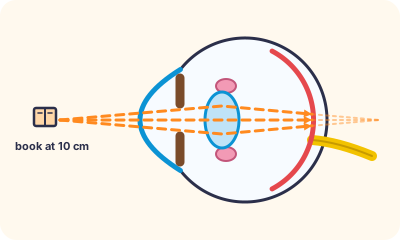
A book is held only 10 cm from a normal eye. Why can the eye not see it clearly?
- The ciliary muscles relax completely, making the lens too thin
- The cornea stops refracting light from very close objects
- The focal length of the eye lens cannot be decreased below a certain minimum limit, so the image falls behind the retina
- The pupil becomes too small to let light in
Show the answer
C. The focal length of the eye lens cannot be decreased below a certain minimum limit, so the image falls behind the retina
For nearby objects the lens becomes thicker and its focal length decreases, but only up to a limit. At 10 cm the image would need an even shorter focal length than the eye can produce, so it falls behind the retina: the picture blurs and the eye feels strain. That is why we hold things at about 25 cm. The ciliary muscles contract (not relax) for near objects, and the cornea and pupil are not the cause.
Topics covered
- Parts of the eye
- Image formation in the eye
- The iris and the pupil
- Working of the eye
- The human eye
- Power of accommodation
- Near point and far point
- Cataract
- Myopia
- Hypermetropia
- Power of a lens
- Defects of vision
- Presbyopia
- Bi-focal lenses
- Eye donation
- Refraction through a prism
- Dispersion of white light
- Rainbow
- Atmospheric refraction
- Twinkling of stars
- Atmospheric refraction and scattering
- Scattering of light
- Key values