Magnetic Effects of Electric Current: CBSE Class 10 Physics practice questions
Practise 50 questions on Magnetic Effects of Electric Current, free, with an explanation for each answer.
Sample questions
A small compass is placed near a straight copper wire. The key is closed, and a current flows. The needle moves away from its north-south position. What does this show?
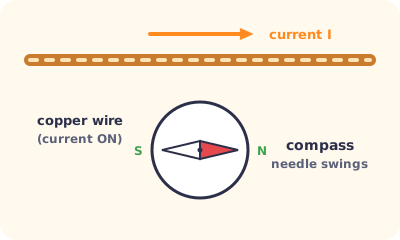
- An electric current produces a magnetic effect (a magnetic field) around the wire
- The copper wire has become a permanent magnet even without current
- The current has heated the needle and made it turn
- The compass needle has been given an electric charge by the wire
Show the answer
A. An electric current produces a magnetic effect (a magnetic field) around the wire
This is Oersted's observation (1820): a current-carrying conductor deflects a nearby compass needle, so electricity and magnetism are linked. Copper is not magnetic, so it is not a permanent magnet. Heating is a different effect of current and cannot turn a needle in a definite direction.
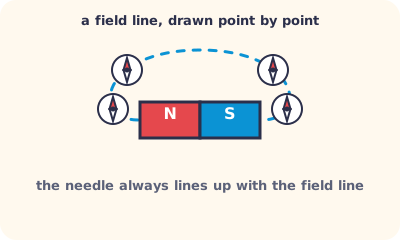
Which statement about the magnetic field lines of a bar magnet is correct?
- They start at the north pole and end at the south pole, so they are open curves
- Outside the magnet they go from south to north
- Outside the magnet they go from north to south, inside from south to north, so they are closed curves
- They exist only outside the magnet and are straight lines
Show the answer
C. Outside the magnet they go from north to south, inside from south to north, so they are closed curves
By convention the field lines emerge from the north pole and merge at the south pole. Inside the magnet the direction is from south to north, so each line is a closed curve. Lines outside are curved, not straight, and they continue inside the magnet.
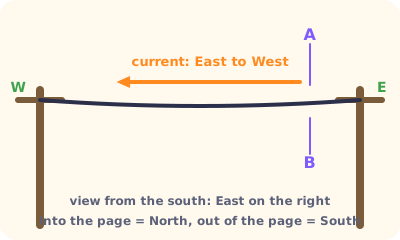
A horizontal power line carries current from east to west. Point A is directly above the wire, and point B is directly below it. What is the direction of the magnetic field at A and at B?
- A: towards the south, B: towards the north
- A: towards the east, B: towards the west
- A: towards the north, B: towards the south
- A: towards the west, B: towards the east
Show the answer
C. A: towards the north, B: towards the south
Point the right thumb west (the current). Over the top of the wire the fingers curl towards the north, and underneath they curl towards the south. Seen from the east end the field turns clockwise, as the textbook says. The field is never along the wire (east-west): it circles around it.
Topics covered
- Oersted's discovery
- Compass needle and poles
- Field lines of a bar magnet
- Properties of field lines
- Magnetic field due to current
- Field around a straight wire
- Right-hand thumb rule
- Strength of the field
- Right-hand thumb rule: power line
- Field at the centre of a loop
- Coil with many turns
- Solenoid
- Force on a current-carrying conductor
- Fleming's left-hand rule
- Force on a moving charge
- Short circuit
- Domestic circuits: power and current
- Household wiring
- Strength of the magnetic field
- Solenoid as a magnet
- Force on a conductor
- Domestic electric circuits
- Fuse
- Earth wire
- Charged particle in a field
- Safety in domestic circuits
- Uses of the magnetic force on a conductor
- Drawing field lines with a compass
- Strength of the field of a coil
- Electromagnet
- Force on a current-carrying rod
- Short circuit and fuse
- Magnetic field and current
- Poles of magnets
- Magnetic field patterns
- Domestic circuits: wire colours
- Domestic circuits