Minerals and Energy Resources: CBSE Class 10 Geography practice questions
Practise 50 questions on Minerals and Energy Resources, free, with an explanation for each answer.
Sample questions
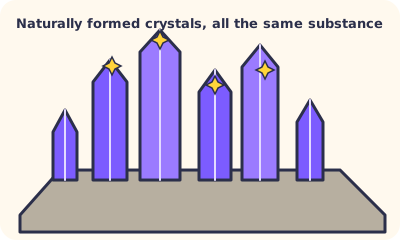
Geologists (scientists who study rocks) define a mineral in a particular way. Which description matches their definition?
- Any rock lying beneath the soil, whatever it is made of
- A homogenous, naturally occurring substance with a definable internal structure
- A man-made alloy produced by heating metals in a furnace
- A mixture of several rocks in fixed proportions
Show the answer
B. A homogenous, naturally occurring substance with a definable internal structure
A mineral is homogenous (the same throughout), naturally occurring and has a definable internal structure. Rocks are combinations of minerals, so calling a rock a mineral confuses the two; alloys are man-made, and a rock is not a fixed mixture. Some rocks, like limestone, consist of just one mineral, but most are made of several in varying proportions.
Rock A and Rock B have the same mineral, shown by the gold dots. Suppose everything else is the same. Which rock is more likely to be an ore worth mining, and why?
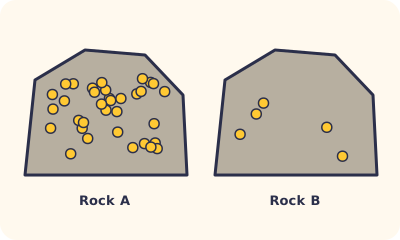
- Rock A, because the mineral is concentrated enough to make extraction commercially viable
- Rock B, because a rock with few grains is easier to crush
- Both equally, because any rock with the mineral in it is an ore
- Neither, because ores are found only in sedimentary rocks
Show the answer
A. Rock A, because the mineral is concentrated enough to make extraction commercially viable
An ore is an accumulation of a mineral mixed with other elements, and its mineral content must be in sufficient concentration to make extraction commercially viable. Rock A passes this test; Rock B has too little. Ores are not limited to sedimentary rocks, and not every rock containing the mineral counts as an ore.
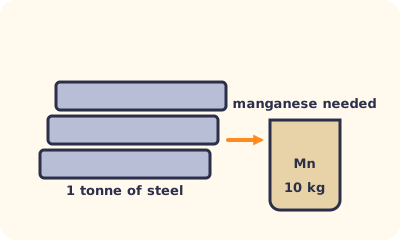
About 10 kg of manganese is needed to make one tonne of steel. How much manganese does a mill need to make 350 tonnes of steel?
- 35 kg
- 350 kg
- 3,500 kg
- 35,000 kg
Show the answer
C. 3,500 kg
kg (3.5 tonnes). 35 kg comes from dividing 350 by 10, 350 kg uses only 1 kg per tonne, and 35,000 kg adds an extra factor of 10.
Topics covered
- What is a mineral?
- Minerals in daily life
- Minerals and life
- Mode of occurrence: ores
- Mode of occurrence
- Rat-hole mining
- Distribution of minerals
- Mines and reserves
- Ferrous minerals
- Iron ore
- Iron ore belts
- Manganese
- Biogas
- Copper
- Mines and minerals
- Tidal energy
- Bauxite and aluminium
- Limestone
- Mica
- Hazards of mining
- Conservation of minerals
- Energy resources
- Conventional sources
- Coal
- Coal in India
- Coal and industry
- Petroleum
- Natural gas
- Electricity
- Nuclear energy
- Non-conventional sources
- Geothermal energy
- Conserving energy