Lifelines of National Economy: CBSE Class 10 Geography practice questions
Practise 50 questions on Lifelines of National Economy, free, with an explanation for each answer.
Sample questions
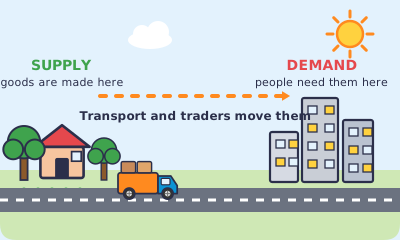
Wheat is grown in a village, but most of the people who need it live in a distant city. What makes it possible for the wheat to reach them?
- The wheat moves from the supply place to the demand place on its own
- Transport, with traders who bring the products to consumers
- Only communication such as radio and newspapers
- Local trade alone, without any movement of goods
Show the answer
B. Transport, with traders who bring the products to consumers
Goods do not move from supply locales to demand locales on their own. Movement needs transport, and traders make the products reach the consumers. Communication alone carries information, not goods, and local trade cannot serve a distant city.
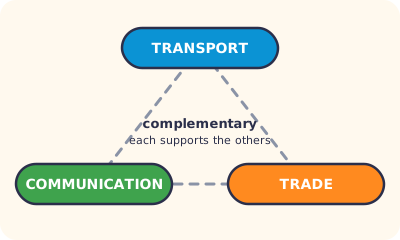
Transport, communication and trade are called complementary. Which statement best explains why?
- Fast, efficient transport is achieved with an equally developed communication system, and together they support trade
- Trade can grow without any transport if communication is good
- Communication makes the movement of goods unnecessary
- Only transport matters, and communication and trade follow on their own
Show the answer
A. Fast, efficient transport is achieved with an equally developed communication system, and together they support trade
The chapter says transport has made the world a large village with the help of an equally developed communication system, so transport, communication and trade support one another. None of them works alone.
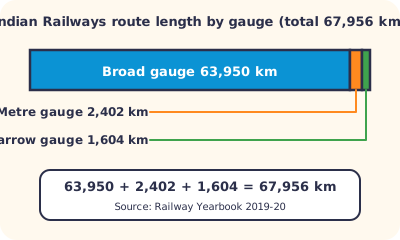
Table 7.1 gives these route lengths: 63,950 km (broad gauge), 2,402 km (metre gauge) and 1,604 km (narrow gauge). The total is 67,956 km. What percentage of the route is broad gauge (to one decimal place)?
- 94.1%
- 96.4%
- 3.5%
- 97.6%
Show the answer
A. 94.1%
Broad gauge share = 63,950 / 67,956 x 100 = 94.1%. Traps: dividing by broad + metre only gives 96.4%; the metre-gauge share is 3.5%; dividing by broad + narrow gives 97.6%.
Topics covered
- Transport and trade
- Roadways
- Railways
- Waterways
- Pipelines
- Sea ports
- Airways
- International trade
- Tourism
- Communication
- Trade and transport