Forest and Wildlife Resources: CBSE Class 10 Geography practice questions
Practise 50 questions on Forest and Wildlife Resources, free, with an explanation for each answer.
Sample questions
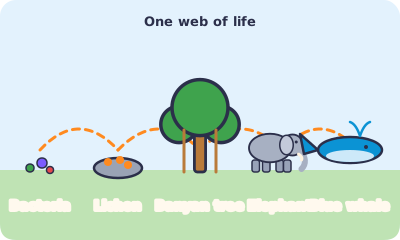
The chapter says that humans and all other living things together form a complex web (an ecological system). Which statement best describes biodiversity (biological diversity), as the chapter explains it?
- Only the number of wild animal species living inside national parks
- The rich variety of wild and cultivated species, different in form and function but closely linked through many interdependencies
- The total area of land covered by forests in a country
- Only the crops and trees that people grow for food and timber
Show the answer
B. The rich variety of wild and cultivated species, different in form and function but closely linked through many interdependencies
The chapter describes biodiversity as being immensely rich in wildlife and cultivated species, diverse in form and function but closely integrated in a system through a multiple network of interdependencies. It is not limited to national parks, to forest area, or to crops and timber alone.
Which of the following is NOT a reason given in the chapter for conserving forests and wildlife?
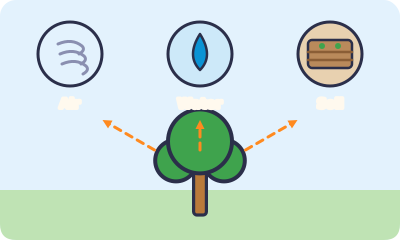
- To preserve ecological diversity and life-support systems such as water, air and soil
- To preserve the genetic diversity of plants and animals for better growth and breeding
- To keep fisheries healthy, since they depend on aquatic biodiversity
- To make all forest land freely available for private timber trade
Show the answer
D. To make all forest land freely available for private timber trade
Conservation preserves ecological diversity and life-support systems (water, air, soil), the genetic diversity of plants and animals, and supports fisheries, which depend on aquatic biodiversity. Opening all forest land for free timber trade would work against conservation, so it is not a reason.
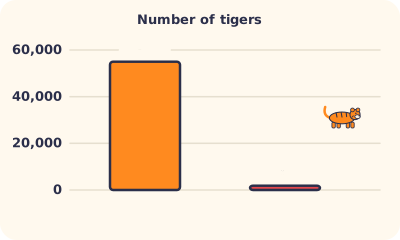
At the turn of the century, there were about 55,000 tigers. By 1973, only 1,827 were left. About what percentage of the tigers had been lost?
- About 3%
- About 30%
- About 97%
- About 53%
Show the answer
C. About 97%
Fall = 55,000 − 1,827 = 53,173. Percentage lost = 53,173 ÷ 55,000 × 100 ≈ 96.7%, about 97%. About 3% is the share that was left (3.3%); 30 is the ratio 55,000 ÷ 1,827 ≈ 30 (about 30 times fewer), not a percentage; 53% copies the digits of 53,173.
Topics covered
- Biodiversity
- Importance of forests
- Why conserve
- Genetic diversity
- Wildlife (Protection) Act, 1972
- Project Tiger
- Community and conservation
- Protected species
- Types of forests
- Sacred groves
- Source-based
- Species with special projects
- Joint forest management
- Timeline
- Widening conservation
- Facts and figures