Manufacturing Industries: CBSE Class 10 Geography practice questions
Practise 50 questions on Manufacturing Industries, free, with an explanation for each answer.
Sample questions
What is manufacturing?
- Growing crops in large quantities on farms
- Processing raw materials into more valuable goods
- Digging minerals out of the earth
- Selling finished goods in a market
Show the answer
B. Processing raw materials into more valuable goods
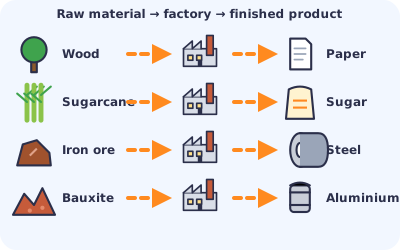
Manufacturing is the production of goods in large quantities after processing raw materials into more valuable products, for example paper from wood, sugar from sugarcane, steel from iron ore and aluminium from bauxite. Growing crops and mining are primary activities, and selling is a service.
Why does the textile industry hold a unique position (special place) in the Indian economy?
- It is self-reliant and complete in the value chain
- It uses no agricultural raw material at all
- It imports all of its yarn from other countries
- It is run only by the government
Show the answer
A. It is self-reliant and complete in the value chain
The textile industry contributes to industrial production, employment and foreign exchange, and it is the only industry that is self-reliant and complete in the value chain. It is closely linked with agriculture, so it does use farm raw material such as cotton.
Which statement about India's position in the world is correct, according to the chapter?

- India is the largest producer of sugar and second in gur and khandsari
- India is second to Bangladesh in producing raw jute
- India is first in exporting jute goods
- India is the largest producer of raw jute and jute goods and is second to Bangladesh as an exporter
Show the answer
D. India is the largest producer of raw jute and jute goods and is second to Bangladesh as an exporter
India is first in production of raw jute and jute goods, but second to Bangladesh as an exporter. In sugar India is second in the world, while in gur and khandsari it is first, so the sugar statement reverses the ranks.
Topics covered
- Meaning of manufacturing
- Household, small and large industries
- Importance of manufacturing
- Agriculture and industry
- Classification by raw material
- Classification by main role
- Classification by capital investment
- Classification by ownership
- Textile industry
- Classification by bulk and weight
- Textile industry: value addition
- Cotton textiles
- Jute textiles
- Chronology of industries
- Sugar industry
- Agro-based industries
- Iron and steel industry
- Aluminium smelting
- Chemical industries
- Fertiliser industry
- Cement industry
- Automobile industry
- Information technology and electronics
- Industrial pollution
- Water pollution
- Control of pollution
- Land and water pollution
- Sustainable development