Money and Credit: CBSE Class 10 Economics practice questions
Practise 50 questions on Money and Credit, free, with an explanation for each answer.
Sample questions
Two people want to swap goods directly, with no money involved. What must be true for the swap to happen?
- Both people must own the same amount of goods
- What one person wants to sell must be exactly what the other wants to buy
- A third person must lend them some money first
- The government must approve every swap
Show the answer
B. What one person wants to sell must be exactly what the other wants to buy
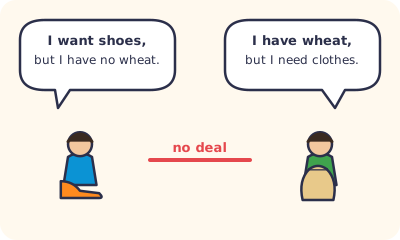
In a barter system goods are exchanged directly, so each side must want exactly what the other has to offer. The chapter calls this double coincidence of wants. In the picture the shoe seller wants wheat's owner to want shoes, but the farmer needs clothes, so no trade happens. The other options invent conditions (equal amounts, loans, government approval) that barter does not require.
A rupee note has no use of its own. Still, everyone accepts it as payment. What is the reason?
- It is authorised by the government of the country and the law does not let anyone refuse rupees in settling transactions
- It is made of gold, silver or copper, so it has value of its own
- Any person or organisation can issue notes and they all look alike
- The Reserve Bank gives a free gift to anyone who accepts notes
Show the answer
A. It is authorised by the government of the country and the law does not let anyone refuse rupees in settling transactions
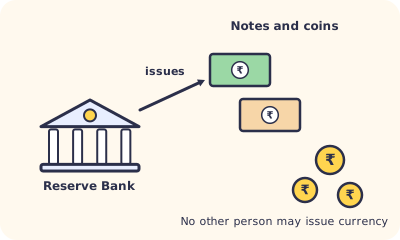
Modern currency is accepted as a medium of exchange because it is authorised by the government. The Reserve Bank issues notes on behalf of the central government, no other individual or organisation may issue currency, and the law says rupee payments cannot be refused in settling transactions in India. Modern currency is not made of precious metal, and the other options are not stated anywhere in the chapter.
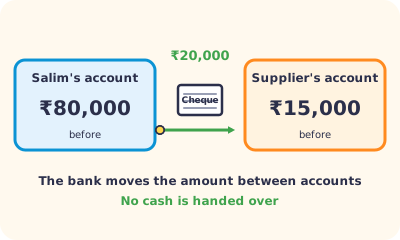
Salim's account has ₹80,000. The leather supplier's account has ₹15,000. Salim pays the supplier with a cheque for ₹20,000, and the cheque is cleared (realised). What are the balances after this?
- Salim ₹1,00,000; supplier -₹5,000
- Salim ₹60,000; supplier ₹35,000
- Salim ₹60,000; supplier ₹15,000
- Salim ₹80,000; supplier ₹35,000
Show the answer
B. Salim ₹60,000; supplier ₹35,000
The bank transfers the amount from one account to the other: Salim's balance decreases () and the supplier's balance increases (). Traps: reversing the direction gives ₹1,00,000 and -₹5,000; forgetting to credit the supplier leaves ₹15,000; forgetting to debit Salim leaves ₹80,000. No cash changes hands in this transaction.
Topics covered
- Barter and double coincidence of wants
- Money as a medium of exchange
- Money removes the need for double coincidence
- Modern forms of money
- History of money
- Currency and its acceptance
- Currency in India
- Deposits with banks
- Cheque payments
- Loan activities of banks
- Cash kept by banks
- Credit
- Salim's festival order
- Credit: Swapna's problem
- When credit helps and when it hurts
- Sonpur: sources of credit
- Terms of credit
- Key terms
- Variety of credit: Sonpur
- Loans from cooperatives
- Informal lenders
- Formal sector credit
- Self Help Groups
- Formal sector credit: Graph 1
- Formal and informal credit: Graph 2
- Grameen Bank of Bangladesh
- Facts and figures