Development: CBSE Class 10 Economics practice questions
Practise 50 questions on Development, free, with an explanation for each answer.
Sample questions
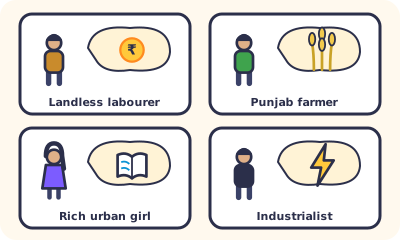
Table 1.1 lists the developmental goals of different people. Which set of hopes (aspirations) does the chapter give for landless rural labourers?
- Assured high family income through higher support prices and cheap labourers
- More days of work and better wages, a good local school for their children, and no social discrimination
- As much freedom as her brother and a chance to study abroad
- More electricity from big dams for factories
Show the answer
B. More days of work and better wages, a good local school for their children, and no social discrimination
The chapter says landless rural labourers want more days of work and better wages, a local school that gives quality education to their children, and no social discrimination so that they too can become leaders in the village. Higher support prices belong to prosperous farmers, study abroad to a girl from a rich urban family, and more dams to industrialists.
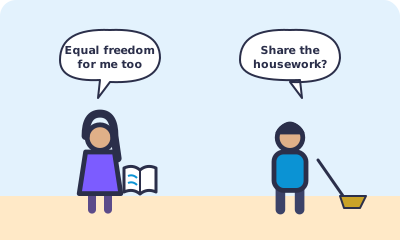
A girl expects as much freedom and opportunity as her brother. She also expects him to share the household work. Her brother may not like this. What does this example show?
- All members of a family always share the same idea of development
- A girl's wish for freedom is not a developmental goal at all
- Different persons can have developmental goals that conflict with each other
- Conflicts over goals arise only between countries, never inside a family
Show the answer
C. Different persons can have developmental goals that conflict with each other
The chapter uses this example to show that two persons or groups may seek things that are conflicting. Their notions of development differ because their life situations differ. The girl's wish for equal freedom is clearly a developmental goal, and conflicts can occur inside families as well as between groups.
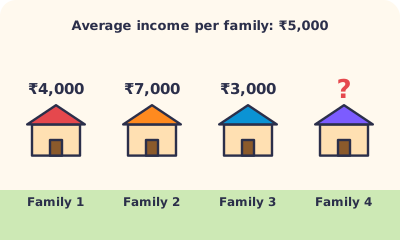
Four families in a country have an average income of ₹5,000. Three of them earn ₹4,000, ₹7,000 and ₹3,000. What is the income of the fourth family?
- ₹1,000
- ₹6,000
- ₹5,000
- ₹14,000
Show the answer
B. ₹6,000
Average × number of families = total income, so the total is 5,000 × 4 = ₹20,000. The three known families earn 4,000 + 7,000 + 3,000 = ₹14,000, so the fourth earns 20,000 − 14,000 = ₹6,000. Traps: using 3 families gives 15,000 − 14,000 = ₹1,000; repeating the average gives ₹5,000; and ₹14,000 is only the sum of the three known incomes.
Topics covered
- Developmental goals
- Conflicting goals
- Different goals for different people
- Income and other goals
- Average income
- National development
- Per capita income
- World Bank classification
- Sources of development data
- Per capita income of states
- Income and other criteria
- Health and education indicators
- Terms used in the tables
- Public facilities
- Education of rural population
- Body Mass Index
- Human Development Report
- Sustainability of development
- Renewable and non-renewable resources
- Crude oil reserves