Our Environment: CBSE Class 10 Biology practice questions
Practise 50 questions on Our Environment, free, with an explanation for each answer.
Sample questions
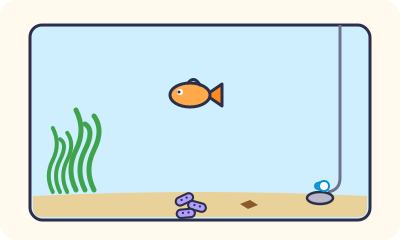
What is the main job of the aerator (oxygen pump) in a human-made aquarium?
- It supplies food to the fish
- It supplies oxygen to the water for the fish
- It keeps the water clean of dead plants
- It gives the plants sunlight
Show the answer
B. It supplies oxygen to the water for the fish
Fish need free space, water, oxygen and food. An oxygen pump (aerator) bubbles air into the water to provide the oxygen. It does not feed the fish or clean the tank, which is why the aquarium still needs cleaning from time to time.
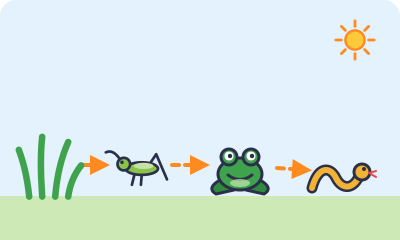
In the food chain shown, which animal depends on the producers only indirectly?
- Grasshopper
- Frog
- Both grasshopper and frog
- Both frog and snake
Show the answer
D. Both frog and snake
Organisms depend on producers directly (by eating them) or indirectly (by feeding on other consumers). Only the grasshopper eats grass. The frog eats the grasshopper and the snake eats the frog, so both depend on the producer indirectly.
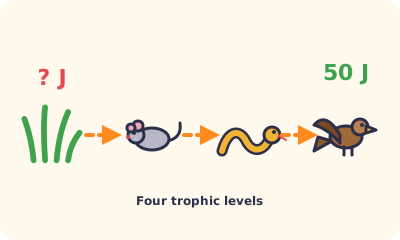
Look at the food chain: grass, mouse, snake, hawk. The hawk receives 50 J of energy. At each step, 10% of the energy is passed on. How much energy was present in the grass?
- 50 000 J
- 5 000 J
- 500 000 J
- 500 J
Show the answer
A. 50 000 J
There are four trophic levels, so there are three transfers. Going backwards, multiply by 10 each time: 50, 500, 5 000, 50 000 J. Using two steps gives 5 000 J, using one step gives 500 J, and counting four steps gives 500 000 J.
Topics covered
- Ecosystem
- Biotic and abiotic components
- Aquarium as an ecosystem
- Decomposers
- Producers
- Consumers
- Food chain
- Trophic levels
- Energy flow
- Food chain length
- Food web
- Biological magnification
- Ozone
- CFCs
- Ozone and CFCs
- Biodegradable waste
- Non-biodegradable waste
- Waste management
- Environment-friendly practices
- Numbers in the chapter
- Key terms