How do Organisms Reproduce?: CBSE Class 10 Biology practice questions
Practise 50 questions on How do Organisms Reproduce?, free, with an explanation for each answer.
Sample questions
A cell is about to divide into two. Why must it first make a copy of its DNA?
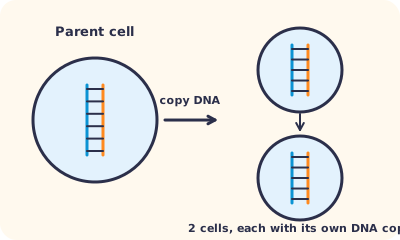
- So that the cell can stop doing respiration while it divides
- So that each daughter cell gets the information (blueprint) for the body design
- So that only one daughter cell gets DNA and the other keeps the cell machinery
- So that the cell becomes larger without dividing
Show the answer
B. So that each daughter cell gets the information (blueprint) for the body design
DNA in the nucleus is the information source for making proteins, so it is the blueprint of the body design. Reproduction therefore starts with a DNA copy, and DNA copying is accompanied by making extra cellular apparatus so that each copy ends up in a cell that can run life processes. Keeping one copy and pushing the other out would not work, because the pushed-out copy would have no organised cell structure.
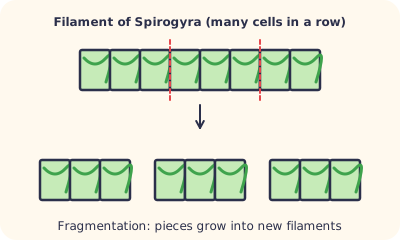
When Spirogyra becomes mature, it breaks up into smaller pieces. Each piece grows into a new filament. Why can this simple organism do this?
- It has specialised organs that are placed at fixed positions
- Its body organisation is relatively simple, so each fragment can grow into a new individual
- It is a single cell, so it divides by multiple fission
- The pieces first need to fuse with pieces of another filament
Show the answer
B. Its body organisation is relatively simple, so each fragment can grow into a new individual
Fragmentation works in multicellular organisms with a simple body design such as Spirogyra. Complex organisms have cells organised into tissues and organs at definite positions, so cell-by-cell division or breaking up would be impractical. Fragmentation involves one parent only, so no fusion is needed.
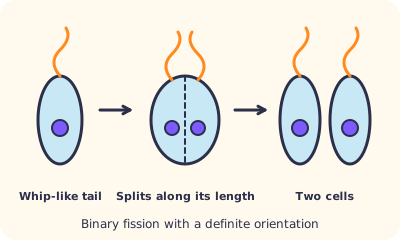
In Amoeba, the cell can split in any plane (direction). But in Leishmania (which causes kala-azar), binary fission happens in a fixed direction. Why?
- Leishmania is a multicellular organism with tissues
- Leishmania reproduces by forming spores instead
- Amoeba has no nucleus, so it splits anywhere
- Leishmania has a whip-like structure at one end, so its body is more organised
Show the answer
D. Leishmania has a whip-like structure at one end, so its body is more organised
Some unicellular organisms show more body organisation. Leishmania has a whip-like structure at one end, and binary fission happens in a fixed direction in relation to it. Amoeba has an irregular shape without such a structure, so it can divide in any plane. Both are single-celled, have a nucleus and divide by fission, not by spores.
Topics covered
- DNA copying
- Modes of asexual reproduction
- Importance of variation
- Fission
- Fragmentation
- Budding
- Regeneration
- Vegetative propagation
- Spore formation
- Tissue culture
- Asexual reproduction
- Sexual reproduction
- Flowers
- Pollination
- Fertilisation in plants
- Germination
- Puberty
- Male reproductive system
- Female reproductive system
- Gametes
- Menstruation
- Placenta
- Human reproduction
- Contraception
- Reproductive health