Heredity: CBSE Class 10 Biology practice questions
Practise 50 questions on Heredity, free, with an explanation for each answer.
Sample questions
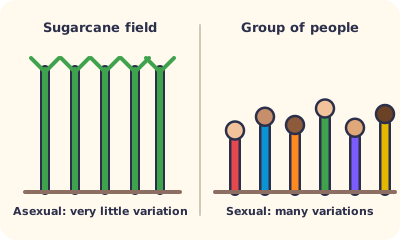
Sugarcane plants in a field look almost the same. But people in a crowd look very different from one another. What is the best reason for this?
- Sugarcane plants have no DNA, so they cannot vary
- Sugarcane reproduces asexually, so its DNA is copied with only tiny errors, while sexual reproduction in humans mixes DNA from two parents
- Humans reproduce asexually, which creates more variation
- Sugarcane plants do not copy their DNA when they reproduce, so nothing can change
Show the answer
B. Sugarcane reproduces asexually, so its DNA is copied with only tiny errors, while sexual reproduction in humans mixes DNA from two parents
In asexual reproduction (sugarcane) the only variation comes from small inaccuracies in DNA copying, so the plants are nearly identical. Sexual reproduction (humans) combines DNA from two parents, so it produces far greater diversity. Sugarcane certainly has DNA, and humans do not reproduce asexually.
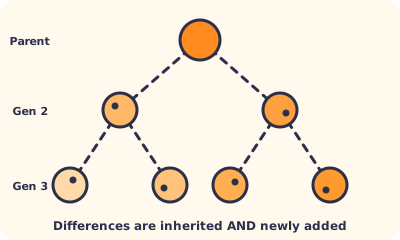
A species reproduces asexually. Trait A is seen in 10% of its members and trait B in 60%. Which trait most likely appeared earlier?
- Trait B, because it has had more generations in which to be copied and spread
- Trait A, because a rarer trait must be older
- Both arose at the same time
- Trait A, because rare traits are stronger
Show the answer
A. Trait B, because it has had more generations in which to be copied and spread
Variations are inherited, so each new generation carries the differences of its parents plus new ones. A trait found in more individuals has had more generations to spread, so trait B is likely older. Rarity does not mean age or strength.
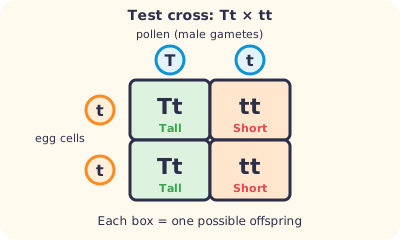
A tall plant with genotype Tt is crossed with a short plant (tt). What ratio of tall to short offspring do you expect?
- 3 tall : 1 short
- All tall
- 1 tall : 3 short
- 1 tall : 1 short
Show the answer
D. 1 tall : 1 short
The Tt parent makes T and t gametes, and the tt parent makes only t. The four boxes are Tt, tt, Tt, tt, so half the offspring are tall and half are short: 1 : 1. The 3 : 1 ratio belongs to Tt × Tt, not to this cross.
Topics covered
- Variation in reproduction
- Accumulation of variation
- Survival and variation
- Variation and evolution
- Inherited traits
- Mendel's experiments
- Dominant and recessive traits
- Predicting crosses
- Planning an investigation
- Mendel's method
- Independent inheritance
- Chromosomes and gametes
- Genes and chromosomes
- How traits are expressed
- Sex determination