Governance and Public Policy: CBSE Class 9 Politics practice questions
Practise 50 questions on Governance and Public Policy, free, with an explanation for each answer.
Sample questions
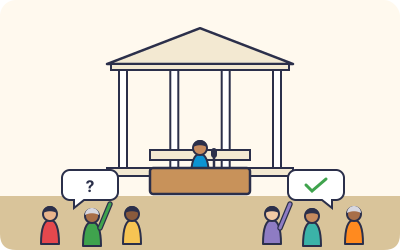
The chapter says that in a democracy that works well, taking part in elections to form the government is not enough. What else does a robust democracy (a strong democracy) need?
- A single strong leader who takes every decision without discussion
- Elections held every year instead of every five years
- Transparent institutions, responsible representatives and the continuous participation of people in public life
- Leaving all public matters to government officers once the votes are counted
Show the answer
C. Transparent institutions, responsible representatives and the continuous participation of people in public life
A robust democracy needs transparent institutions, responsible representatives and the continuous participation of people in public life. Democratic governance rests on transparency, accountability, participation and the rule of law, and it puts citizens at the centre, so it is people-centric and welfare-oriented. More frequent elections, one all-powerful leader, or handing everything to officers would all leave people out of decisions between elections.
In a village, the panchayat has the power to put up street lights. Residents point out dark spots, report lights that stop working and give feedback. The lights are then repaired and looked after. According to the chapter, this whole process of planning, putting up and looking after the lights with people's help is an example of…

- government, because only the panchayat is involved
- governance: the process by which a public service is planned, implemented and maintained with people's involvement
- the judiciary, because residents complain about faulty lights
- a private policy, because it concerns only one street
Show the answer
B. governance: the process by which a public service is planned, implemented and maintained with people's involvement
The panchayat or municipal corporation is the government: the institution with the authority to provide the service. Governance is the process by which the street lighting is planned, implemented and maintained, with people identifying dark spots, reporting faulty lights and giving feedback. It ensures the continuous delivery of the service: well-lit streets and greater public safety. Option A ignores the residents' role, and no court is involved.
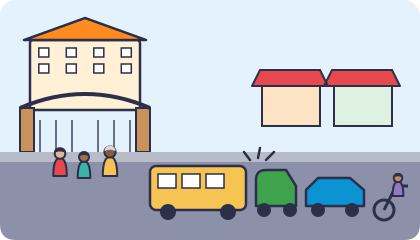
Every morning and afternoon, heavy traffic blocks the road outside your school gate. The chapter's activity gives some options. Which one needs action by a public authority outside the school?
- Form a group of student volunteers to regulate traffic during rush hours
- Ask the school management to open another gate on the other side
- Change school timings so that they do not clash with the busiest market hours
- Ask the local people's representative to get a traffic signal installed
Show the answer
D. Ask the local people's representative to get a traffic signal installed
A traffic signal on a public road is a public service, so it needs action by public authorities. That is why the issue goes to the local people's representative, whose role is to raise public issues. Volunteers, a new gate, a shifted pick-up point or new timings can all be decided by the school itself. Weighing such options and choosing one is a small version of how public problems are solved.
Topics covered
- Beyond elections
- Let's Explore: a flooded town
- Meaning of governance
- Government and governance
- Evolution of governance in India
- Indian values in public life
- Traditions of good governance
- Rām Rājya
- Rājadharma
- Who makes governance good?
- Features of good governance
- National Good Governance Day
- Challenges to good governance
- E-governance
- Let's Explore: life before and after e-governance
- Limits of e-governance
- Meaning of a policy
- Policy and public policy
- Meaning of public policy
- What is 'public' about public policy?
- Policy or public policy?
- Key stakeholders in policy-making
- Let's Explore: traffic at the school gate
- Case study: a ramp to better healthcare
- Calculation: budget allocation
- The policy cycle
- Case: a tree-planting programme
- Stages of the policy cycle
- Calculation: evaluating results
- Don't Miss Out: NEP 2020
- Calculation: NEP consultation
- Policy, programme and scheme
- Policy coordination: Khelo Bharat Niti
- Multi-level coordination
- Citizens and good governance